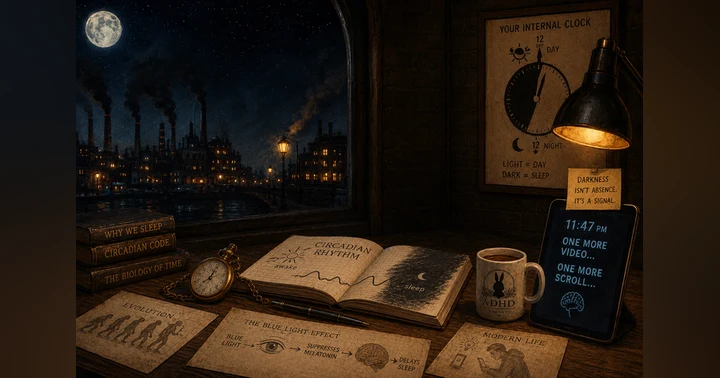
The Science And History Behind Your Nightly Shutdown

Send us Fan Mail You spend nearly a third of your life unconscious, unable to hunt, react, or protect yourself and somehow nature decided that was the best deal on the table. That contradiction is where we start: if evolution trims anything that hurts survival, why does sleep exist at all, and why do so many species share it? I follow the trail from ancient dream beliefs to Aristotle’s shift toward natural observation, then into the modern world where gas lamps, electricity, and factory sche...


Key Takeaways
- Throughout the history of sleep science, humanity has evolved from viewing slumber through the lens of ancient dream myths and gods to understanding it as a critical, highly structured biological necessity.
- Sleep is not a single off switch, but a complex series of cycling stages including REM sleep, where the brain organizes memories and experiences while temporary muscle paralysis called REM atonia keeps us safe.
- The discovery of the glymphatic system revealed that the sleeping brain acts like a city at night, deploying fluid to wash away toxic waste products that accumulate during waking hours.
- The invention of gas lamps and electric lighting radically altered our relationship with darkness, creating a mismatch between our ancient circadian rhythms and modern 24-7 lifestyle demands.
- Chronic sleep deprivation severely impacts focus, mood, long-term health, and memory consolidation, proving that rest is an indispensable component of learning, athletic recovery, and overall performance.
You spend nearly a third of your life unconscious, unable to hunt, react, or protect yourself and somehow nature decided that was the best deal on the table. That contradiction is where we start: if evolution trims anything that hurts survival, why does sleep exist at all, and why do so many species share it?
I follow the trail from ancient dream beliefs to Aristotle’s shift toward natural observation, then into the modern world where gas lamps, electricity, and factory schedules turned nighttime into “extra time.” From there, the mystery moves into medicine and neuroscience with Nathaniel Kleitman’s relentless sleep research, including bold early experiments that helped reveal the body’s internal clock, or circadian rhythm.
Then the real plot twist hits: REM sleep. With Eugene Aserinsky’s discovery of rapid eye movement, sleep stops being a single off switch and becomes a structured cycle of stages with different jobs. We talk dreams, REM atonia (your brain’s built-in parking brake), memory consolidation, emotional processing, and why practice sticks better after real rest. We also dig into the glymphatic system research suggesting the sleeping brain ramps up a kind of nighttime cleanup, clearing waste that builds during the day.
Modern life still tries to outsmart biology with phones, streaming, caffeine, and shift work, but the bill always comes due in focus, mood, safety, learning, and long-term health. If this rabbit hole changes how you think about sleep, subscribe, share the episode with a friend who brags about running on fumes, and leave a review. What’s the one habit that steals your sleep most?
Follow us on Facebook: https://www.facebook.com/share/1BXmjoArss/?mibextid=wwXIfr
Instagram:
https://www.instagram.com/adhdtheory?igsh=MXZ6eGgzMGlvNHJy&utm_source=qr
TikTok:
https://www.tiktok.com/@adhdtheorypod?_r=1&_t=ZP-98QJNZBkBWI
Frequently Asked Questions
What is the history of sleep science?
The history of sleep science evolved from ancient Egyptian and Greek myths about gods and healing temples into natural observation by Aristotle, eventually transforming into modern neuroscience through pioneers like Nathaniel Kleitman and the discovery of REM sleep.
Why do we have REM sleep?
REM sleep, discovered by Eugene Aserinsky, is a highly active stage of sleep characterized by rapid eye movements and vivid dreaming where the brain processes emotions, consolidates memories, and prevents physical movement via REM atonia.
What is the glymphatic system in the brain?
The glymphatic system is the brain's nightly cleanup mechanism discovered in 2012, which flushes out cellular waste and toxins that build up during the day while we are unconscious.
How does artificial light affect our circadian rhythm?
Artificial light from phones, screens, and electric lighting tricks our internal biological clock into ignoring natural darkness, disrupting our circadian rhythm and making it harder to get restorative rest.
00:00 - Sleep’s Evolutionary Paradox
08:10 - From Dream Myths To Aristotle
11:50 - When Night Became Optional
15:08 - REM Sleep Changes Everything
19:03 - Memory Sorting And Nightly Repair
22:38 - Circadian Rhythm Versus Modern Life
30:21 - Sleep Shapes Health And Identity
39:27 - That’s Wild Sleep Stories
51:15 - The Invisible Work Behind Your Life
Sleep’s Evolutionary Paradox
SPEAKER_00Every single day you do something that should have never survived evolution, you become unconscious, and not for a few seconds, but for a few hours. You lose awareness of the room around you, you can't react very quickly, you can't hunt or gather food or protect yourself. And I mean, for most of history, that was incredibly dangerous if you actually did that. Which is why this question kind of bothered me a little bit. If evolution is so good at getting rid of things that make survival harder, why didn't it get rid of sleep? The more I looked into it, the weirder it became. Like humans, dogs, birds, whales, I mean, even jellyfish sleep. All in different bodies, in different environments, and hundreds of millions of years of evolution, and yet somehow we all arrived at the same solution. That doesn't happen by accident. For thousands of years, people tried to explain it. Like some people believed dreams were messages from the gods, and others thought the soul wandered while the body rested. But scientists began asking a little bit of a different question. Not what sleep means, but what it does. And they discovered something that was a little bit stranger than anybody expected, because while you think you're doing absolutely nothing, your brain is doing some of the most important work it can. And it turns out the biggest mystery isn't why we wake up, it's why we never have to stop in the first place. That's the rabbit hole we're following today. Sleep.
unknownCome with me.
SPEAKER_00I'm Andrew Perry, and every week we follow another rabbit hole through history, science, and the people whose curiosity changed the way we understand the world. This week, we're talking about something you've done every single day of your life. Something every person you've ever known has done, and pretty much every animal on earth does. And yet, scientists still don't have one simple answer for why. We spend nearly a third of our lives asleep, and that's roughly 26 years for the average person. That's 26 years spent doing something so essential that your brain will eventually force you to do it, whether you want to or not. So why? What is your brain actually doing while you're unconscious? Why do dreams exist? And why can dolphins sleep with only half their brain at a time? And how did one of the most ordinary parts of life become one of biology's biggest mysteries? So grab a seat, get comfy, and let's follow this rabbit hole. We set alarms to interrupt it, we drink coffee to delay it. We hit snooze because we'd rather have nine more minutes of it. And if you heard our last episode, you'll get what I'm saying. But we hardly ever stop and ask what it actually is. A few weeks ago, I was getting ready for bed, same as normal. I plugged my phone in, I set my alarm, turned off the lights, same routine I've done a million times. And then I caught myself doing something I'd never really thought about before. I was completely confident that I'd wake up in the morning. And working in my field in EMS, that's, I mean, that's a that's a heck of a thought because you learn that that's not always the case. And it's that's a weird kind of confidence to have. Like every night we willingly hand over something we spend the entire day protecting. Like we just hand our brains over to whatever. We stop paying attention to the world, we lose track of time, I mean, hours disappear and we don't even notice. Like we wake up and just continue. We act like that's normal, but is it? Because I mean, most people would probably say sleep is just the body's way of resting. And at first, that sounds like a perfectly good answer. Except the more I thought about it, the less satisfying it was. Because rest doesn't really explain anything. Like, why do we have to rest? Why do we why can't we just simply stay awake? Why can a person survive for weeks without food, but just a handful of days without sleep before the brain begins to just shut down? Why do we have dreams? Why do babies spend most of their days asleep? Why do teenagers seem like they're powered entirely by naps? I mean, and our grandparents somehow wake up before before sunrise without an alarm. My grandpa wakes up at like 5 a.m. and has coffee and watches the news and everything else, and I pfft I'm lucky if I even get up at 6, 6:30. The more questions I asked, the more sleep stopped looking like a break from life. It started looking like one of the most important things that life does. Think about how much of the world quietly revolves around sleep. I mean, parents rock babies until their eyes shut and they go to sleep. Students, they for some reason just stay awake a little bit longer before an exam. And night shift workers find a body that's convinced it should be somewhere else. Doctors work overnight to care for patients, truck drivers pull into rest areas just because it's not worth the risk. I mean, entire businesses exist because we can't sleep. Others exist because we can't stay awake. Hotels, mattress companies, coffee shops, they even have sleep clinics. White noise machines, blackout curtains, all of that revolves around sleep. An entire economy has grown around something we still don't even understand. And that surprised me a little bit because we we live in an age where we can watch galaxies billions of light years away, and we can edit genes and transplant organs and send you know spaceships way beyond the edge of the solar system. Surely something as ordinary as sleep should already be solved, except it's not. Scientists have learned an incredible amount over the last century, and they know what happens during different stages of sleep. They know how many systems are involved, they know what happens when we don't get enough of it. But if you ask one simple question, why did sleep evolve in the first place? the answer becomes a lot less certain. There are good ideas, there's, I mean, there's strong evidence, like there's compelling theories, but no single explanation that answers every question. I mean, think about that. Like I thought sleep would be one of those topics where science had everything just wrapped up with a bow and all good. Instead, I found out it's one of biology's oldest mysteries. But I mean, people have been asking this question for a thousand years, way before brain scans and like sleep labs, before anybody knew what a neuron was, somebody looked at a sleeping person and wondered, you know, what's going on in there? Who was the first person to ask that question? Like, what did they think was going on? And how do we go from myths about dreams to watching you can see the electrical signals move through the sleeping brain? I mean, that question has quite a story, and it started a lot earlier than what I thought. One
From Dream Myths To Aristotle
SPEAKER_00of the first things I came across when I was researching sleep is that this story doesn't really have a beginning. Nobody invented it, nobody discovered it. Sleep is older than humanity. It's older than mammals, it's older than dinosaurs. I mean, it's it's sleep. Way before the first human ever watched the sunset, living things were already cycling between periods of activity and rest. So if sleep has always existed, where do you even start telling its story? I mean, I don't think it begins with sleep, I think it begins with, as always, curiosity. At some point thousands of years ago, somebody watched another person sleeping and asked a question that had probably never been asked out loud before, which was, what's happening what's happening to them? I mean, for a long time, the answers weren't scientific, they couldn't be. Science wasn't big. People explained sleep using the best ideas they had. The ancient Egyptians believed that dreams could carry messages from the gods. In Mesopotamia, kings sometimes they made important decisions based on dreams that they believed were warnings or a guidance. I mean, the ancient Greeks even built places called healing temples where people would spend the night hoping a dream might reveal the cure to an illness. For most of history, the mystery wasn't whether sleep mattered. Everybody agreed that it did. The mystery wasn't it wasn't that if it mattered. Everybody did agree that it did, but it's was it was different. It was what it meant. And then around the fourth century BC, somebody approached it a little bit differently. And we've talked about him before on this show. If definitely, if you remember the photography episode, his name was Aristotle. Now, today we remember Aristotle for philosophy and logic and science and a smidge on the photography side, but he was also something else. And we talked about before how he was just an incredible observer. In our photography episode, we talked about how he observed the shadows and the sunlight shining through the leaves on the tree. Well, Aristotle believed that before you could explain the world, you had to pay attention to it. Instead of asking whether dreams came from the gods, Aristotle asked a lot, a lot simpler question: what is sleep? He watched animals, uh, he compared different species, recorded what he saw. A lot of his conclusions were wrong. Now, don't get this twisted. A lot of Aristotle's conclusions were wrong, but a lot of them were right. In this instance, he believed, for example, that uh sleep originated from the heart rather than the brain. But that's not the most important part. The important part is that he changed the question itself. Instead of searching for supernatural explanations like what has already been talked about and what they'd already believed, he searched for natural ones. And that shift changed a lot. For almost 2,000 years, people kept asking the same question with slightly better tools. So doctors made observations, um, natural philosophers debated ideas, scientists were performing experiments left and right. Every generation inherited the mystery from the one before it. So then the world itself began to change.
When Night Became Optional
SPEAKER_00By the late 1800s, electricity was transforming cities. Factory workers, they would work through the night, artificial light would just push bedtime way later than nature ever intended. People weren't just sleeping anymore. They were choosing not to. And that created a brand new mystery. If humans could stay awake longer than ever before, what happened when they did? Doctors began noticing patterns in people who regularly lost sleep. They would become forgetful, their reaction times would slow down, they would make mistakes that they normally wouldn't. And so something something important was happening during sleep, but no one knew exactly what it was. The mystery had moved from philosophy to medicine. That caught the attention of a young scientist who refused to let the question go. His name was Nathaniel Kleitman, and Kleitman was born in 1895 in what is now the Ukraine, before he immigrated to the U.S. as a teenager. He eventually became a physiologist at the University of Chicago. While much of the scientific world focused on disease and nutrition or anatomy, Kleitman was fascinated by something everybody else just took for granted. Sleep. His colleagues thought he was crazy. Like they thought it was an odd career choice. Why dedicate your life to something that people just do while they're unconscious? And that's what exactly fascinated him with it, is the that the biggest mysteries were just hiding inside the things that we don't notice. Kleitman wanted to understand what happened inside the sleeping brain. So, not philosophically, not symbolically. It was he wanted to know physically what was happening inside the body. So him and his students, they spent years, like years, sleeping in labs. They were recording observations, they were running experiments, they even lived for weeks inside of Kentucky's Mammoth Cave, which is completely cut off from daylight. They just wanted to study. They wanted to study what happened when the body lost all sense of time. It was a kind of a wacky experiment for the time. Everybody made fun of him, and they really they really thought this guy was insane. But it did ask a pretty modern question. Does the brain know what time it is, even when the sun is not there? And the answers they found would change neuroscience forever. But the biggest breakthrough came relatively by accident. One of Kleitman's graduate students, he noticed something no one expected. Tiny movements hidden beneath closed eyelids and babies. Now, in babies. So at first it didn't seem important to them, and in reality, they opened the door to an entirely new understanding of what the brain had been doing the whole time. And that's where our story goes next. Nathaniel
REM Sleep Changes Everything
SPEAKER_00Kleitman had spent years trying to answer a simple question: What is the brain actually doing while we're asleep? The problem was he couldn't watch it. Well, at least not very well. Scientists could observe breathing and they could measure heart rate and watch someone's eyes, but the sleeping brain was mostly hidden. So then in the early 1950s, one of Kleitman's graduate students noticed something that almost everybody else had overlooked. His name was Eugene Azarinsky. Azarinsky was studying sleeping infants when he noticed their eyes were darting back and forth beneath their eyelids while they were closed. The kids were asleep, and he just noticed that the eyes were moving. He noticed they would go back and forth, and not every now and then they would constantly be moving. It didn't make a lot of sense at the time. If sleep was the brain shutting down, then why were the eyes acting as if they were following something? So instead of ignoring it, Azarinsky kept recording, and he started to notice a pattern. He showed Kleitman, and together they studied this for a while and they published their findings in 1953. It turns out the tiny eye movements marked an entirely different kind of sleep. Today we call it rapid eye movement or REM sleep. And that discovery completely changed the way that scientists were thinking about sleep, because suddenly sleep wasn't one thing, it was several different states repeating in a ridiculously organized way. So every night, whether you noticed it or not, your brain would move through these stages over and over again. It's less like sleeping. It's more like flipping a light switch. Like you're flipping the light switch, it goes on and off, and you'll move back and forth in slow movements. Like in a symphony. Each one has a different job. Uh you would drift from wakefulness into a lighter sleep. Your heartbeat would slow down and your breathing would become more regular, your muscles would begin to relax, and then you would just descend into a sleeper sleeper. Into a much deeper sleep. This is when your body gets busy repairing muscle and like releasing releasing growth hormones, uh supporting your immune system, and recovering from everything that the day had demanded of it. And then almost as suddenly as it slowed down, your brain would speed back up. Your eyes would dart back and forth and back and forth beneath your eyelids, your breathing would become irregular, your heart rate would change. Brain activity became so intense that scientists would only look at the signals, they would think you were awake. Except you aren't. This is where most vivid dreams happen, which raises another question: if the brain is this active, why don't we just get up and act out our dreams? Though the answer is pretty strange. During REM sleep, your brain temporarily disconnects most of your skeletal muscles. It's called REM atonia. So think of it as the brain quietly flipping the parking brake while the imagination goes for a drive. Like without it, many of us would literally act out our dreams, and some people actually do. So there's a rare condition, it's called REM sleep behavior disorder, and that prevents the normal muscle paralysis that causes sleepers to not act out their dreams. In this situation, they would punch and kick and run or even jump out of bed while they're dreaming. So it's one tiny system with enormous consequences. But dreams aren't the only thing happening as researchers continue to study. Sleep. Another picture started to come out of there.
Memory Sorting And Nightly Repair
SPEAKER_00Imagine you've spent the entire day working in a busy office, and by the end of the afternoon, your desk is covered with papers. Some are more important, some are junk, some need to be filed, and others just belong in the trash. You probably wouldn't have everything exactly where it landed. You wouldn't keep it there. You'd organize it. And that's a little bit like what the brain appears to do every night. Throughout the day, you're constantly collecting information, like a conversation with one of your friends or the route that you drive to work, maybe a new password that you had to make up, because it just forces you to come up with one every 90 days, the smell of fresh coffee, a funny joke, or a really stressful meeting. Like your brain can't keep every single detail of all of that forever. So while you're asleep, your brain is making decisions on what should stay and what should disappear. Like what deserves a permanent place in the memory and what doesn't. So researchers now believe that the different stages of sleep they contribute to different parts of that process. Some memories become stronger and motor skills will improve. Emotional experiences are processed in this sleep. The brain begins connecting today's experiences with the things you already knew yesterday. So that's so that's why musicians when they get a good night's rest and then they've got a show the next day, that's why they play better. That's why they play more smoothly. Um athletes, when they perform, they will do better, significantly better. It's measurable. Students, I mean, they remember a lot more when they would actually get a good night's sleep and go in and take finals the next day. Everybody wants to cram all night and be up all night. You will do better with a full night's rest. Your brain hasn't stopped working. It's it works where you can't watch. So when you're asleep, that's when you're becoming you. Then came another discovery that surprised scientists again. In 2012, there was a Danish neuroscientist. Her name was Megan Nedegaard. Her and her research team described what appeared to be one of the brain's housekeeping systems. They found evidence that while we sleep, fluid moves through the brain and it helps carry away waste products that build up during the day. So think of a city after everybody's gone home. There's no traffic, the streets are quiet, and then the garbage trucks come out. It's not because they're the most exciting part of the city, it's because tomorrow depends on them doing their job. They take out the trash so the rest of the world can function. Well, your brain is following a sim a similar rhythm. When the work of the day is done, another kind of work begins. And then that's kind of the biggest surprise of all is that we spend our waking lives believing that the important things happen while we're awake. Like while we're learning or working or talking or thinking or any of that. But all of it comes into play when you go to sleep. So much of what allows us to do those things tomorrow happens after we've stopped paying attention to them. The brain doesn't simply use sleep, it depends on it. Which brings me to my next question. If sleep
Circadian Rhythm Versus Modern Life
SPEAKER_00is so carefully built into our biology, why does modern life seem determined to fight against it? I mean, and the answer is going to change the way that the world, well, you and me, the way we think about sleep. And it might as well change everyone else right along with it. So for what seemed like forever, no one was managing their sleep. They just kind of followed it. The sun came up, people woke up. The sun went down, people went to sleep. There wasn't a whole lot of choice there. Candles were super expensive, oil lamps didn't produce a lot of light, and working after dark was ridiculously difficult and dangerous, and usually not even worth the effort. So the night belonged to sleep. That's what it was for. That rhythm had pretty much guided humans for thousands of years. And then we decided to come along and stick our nose in it. We changed the light. Now all at once, just one invention at a time. In the early 1800s, gas lamps they were starting to illuminate the city streets, and factories would stay open later, stores would extend their hours. People discovered that they could keep going way after the sun went down. And then in comes electricity. So we can thank Thomas Edison for that one. Many other inventors helped him, but Thomas Edison made them they made electric lighting practical. In the late 19th century, they weren't trying to change sleep necessarily. They were trying to conquer the darkness. And history has a funny habit of just changing things that nobody intended to change in the first place. So suddenly, nighttime wasn't really night anymore. The homes were brighter, the businesses would stay open much, much later, and factories could run 24-7. Cities developed a nightlife unlike anything that any previous generation had ever known. For the time, millions of people started living on schedules that their ancestors never could have even imagined. Our technology changed almost overnight. Our biology did not, obviously, but that mismatch just created an entirely new problem. Through all of human history so far, darkness had been one of the brain's most reliable signals that it was time to go to bed. And now people could flood a room with light at the flip of a switch. The brain couldn't tell the difference between noon and midnight nearly as well as it ever had. And then came another transformation. The Industrial Revolution wasn't just changing machines, it was changing time itself. I mean, workers no longer they didn't have to stop when the sun disappeared. Factories needed overnight crews, and railroads operated 24 hours a day. Hospitals never slept. Police officers would work through the night, and eventually you had us, EMTs, paramedics, firefighters, pilots, truck drivers, dispatchers. I mean, that's that's a lot of people just working 24-7. You we conquered the night. The night was no longer a scary place where you could get murdered by some vicious animal. I mean, it still is in some places, but you know, you get the point. Entire professions began asking humans to stay awake when millions of years of evolution expected us to be asleep. Our bodies cooperate to a point, but they never completely forget what time they're designed for. Like scientists would eventually they give, like they would give that internal clock a name, which is where we got circadian rhythm. It think of it, it's a clock you can't see. It's a biological rhythm that quietly just kind of hangs out in almost every cell in your body. So before your alarm goes off, your brain is already preparing to wake you up, like way before bedtime. It's it's beginning to prepare you for sleep, and it does all of that, whether you're paying attention or not. Like the modern world, however, has become very good at interrupting those signals. Like coffee lets us borrow alertness and phones, they just phones. Don't even get me started. Phones glow beside our beds, and you know, streaming services, they're just like, you know, do you want to watch another episode? Work emails, they're coming in at 10 o'clock at night, and we can ignore darkness. Like we, it's just we don't pay attention to that anymore. We can ignore darkness almost indefinitely, but our brains never really got that update. Like researchers began to notice there's consequences. I mean, it's not just falling asleep. Hospitals found that exhausted healthcare workers were more likely to make mistakes. Hmm. How about that? Airlines, they were studying pilot fatigue. Uh, transportation officials, they investigated crashes where tired drivers had just drifted off. Employers figured out that productivity doesn't always increase when people work longer hours. Sometimes it fails. Because an exhausted brain isn't just slower, it's different. Sleep gradually stopped being viewed as a luxury. It became a public safety issue, a workplace issue, a healthcare issue, an education issue. One question changed everything. Should schools really expect teenagers to learn at 7:30 in the morning when adolescent brains naturally shift towards later sleep schedules. A lot of communities were asking that. Like so a lot of them would change their school start times and others didn't. But the conversation itself was, I mean, it was new. Like for most of history, people assumed the solution to being tired was simple, just try harder. Okay. But now we understand that something our ancestors didn't really know. Sometimes the problem isn't the motivation, it's actually biology. And that's one of the biggest ways our understanding of sleep has changed the world. We stopped seeing sleep as wasted time and started seeing it as necessary time. Not because scientists wanted us to sleep more, but it was because the evidence kept pointing in the same direction. The brain does not negotiate forever. Eventually, it will collect. And maybe that's the biggest transformation of all is for centuries, sleep was something people accepted, and they did it because it's just what it was. Today, it's something we're finally beginning to start to understand. But I mean, understanding sleep, it created one final question. It if it's if it shapes nearly every decision that we make and every emotion that we feel and every memory that we keep, then how much of the person we become later on in life is really shaped by what happens while we're asleep. And that's where our story turns next.
Sleep Shapes Health And Identity
SPEAKER_00When scientists finally began understanding what sleep was doing, they stumbled onto a much bigger discovery. Sleep wasn't just keeping us alive, it was shaping the people we became. So think about your own life for just a second. Like if you remember having uh, let's say learning to ride a bike. Maybe the first time you drove a car or uh the face of somebody that you fell in love with, the sound of somebody's laugh, or the route to your favorite restaurant, maybe that new password you made. I mean, those moments they happened while you were awake, and and they did. Like they they happened while you were awake, but that's only half the story. What happens after you fall asleep, that probably matters just as much. Every day your brain is flooded with information, thousands of sites, sounds, conversations, decisions, problems, you know, little tiny moments that barely seem important, but I mean, you like we've talked about your brain can't keep all of it. It would drown in details. So every night it just makes choices, and some memories are strengthened and others fade away. It's not because they're unimportant, but because making room for tomorrow, you've gotta you've gotta let go of things that you learned today. I guess we do that little insert here, and we'd be like, oh, here's a real inspirational quote. He'd be like, you know, making room for tomorrow requires letting go of yesterday. Yeah that's that's a remarkable thing. I mean, when you stop to think about it, the person you are today is partly the result of thousands of nights spent deciding what version of your life was worth remembering. So your brain created who you are now based on all the sleep you had or didn't have before. And sleep doesn't just protect your memories, it shapes them. Like, and memories shape identity, which means sleep has helped shape you. And that realization changed way more than neuroscience. It changed medicine. Like doctors were noticing that poor sleep wasn't a symptom of illness. Sometimes it was actually part of the cause. Like a lot of research has found that there are connections between chronic sleep loss and heart disease, type 2 diabetes, uh, depression, anxiety, obesity, your weakened immune system, and a whole bunch of other health problems. Like the body doesn't just get tired without sleep, it becomes less capable of actually taking care of itself. So for generations, students they wore like, you know, they did those all-night study sessions. They wore them like a badge of honor. Like, but the assumption was simple like more hours awake were more hours learning. Except research kept pointing in the opposite direction. Learning doesn't end when you close the textbook in many ways. I mean, it it when the brain starts making sense of what you've learned, that happens when you sleep. Teachers began encouraging students to sleep before exams, which I mean, you've heard it. You went to school, you're like, oh, you make sure you get a good night's rest and a good breakfast. Some schools were pushing for later start times after the research came out, and it did discover that teenagers naturally experience shifts in their biological clocks during adolescence. So the goal wasn't giving students extra sleep because it felt nice, it was giving their brains a better chance to learn. Like athletes, they they went through the same situation. They discovered something really similar to that. Professional teams literally now hire sleep specialists. Not it's not because sleeping is training, but because recovery is training. Like that's part of your training, is the recovery. It's the most important part of the training. A basketball player can spend hours practicing free throws, and a muscle can just rehearse the same difficult paths over and over and over and over again. And say, like me, like an EMT, I can repeat the same medical skills until they become second nature. But sleep is often like it's the thing that helps those repetitions become lasting abilities. Practice. So, okay, so practice introduces the lesson. And then sleep is what takes the lesson and preserves it in your mind. It just yeah, that's where it gets locked in, that's where it gets stored. Even creativity that, I mean, that benefits from it. So there was a chemist, and his name was August. And don't ask me what his last name is because it was very, very complicated. It we'll just call him August. He described a dream that helped him imagine the ring-shaped structure of benzene after years of trying to solve the puzzle. Like there was a Russian chemist, his name was uh Dmitry Mandelev. He recalled falling asleep while he was struggling to organize the chemical elements, only to wake up with the arrangement that became the periodic table. Like it was taking shape in his mind, the periodic table. Historians, they okay, so they debate a little bit about how those stories unfolded, but they capture something that scientists continue to study today. Sometimes the sleeping brain notices patterns the waking brain couldn't quite see. So then there's something we all recognize. Have you ever noticed how everything feels worse after a terrible night's sleep? Like the traffic, it just kind of irritates you a little bit more. The it just everything is different. The inconvenience of anything feels bigger, and you have less patience and less focus, less emotional margin. The world hasn't necessarily changed. It's the same world, but your ability to navigate it is what changed. Like that's that's one of sleep's biggest influences, is it quietly sits there and it does its job overnight and it it affects things. It affects not only what we remember, but how we experience the world, our relationships, our decisions, like our kindness and resilience, our confidence or our fears. They're all influenced, or at least in part, by whether our brains had the opportunity to do their nightly work or not. And maybe that's why sleep has never really been optional. Because not because nature wanted us to spend a third of our lives unconscious, because consciousness itself appears to depend on what happens during sleep. So, I mean, the trade-off is amazing. Like modern life gives us opportunities our ancestors never imagined, like electric lights and global communication, 24-hour hospitals, EMS, international travel, streaming, and coffee shops literally everywhere. But those things have made life richer in a whole bunch of ways for us, but they've also made it easier than ever to just borrow a little bit of time from the night, take away some sleep. And sometimes we have good reasons, like a newborn baby or a night shift, or you know, there's good reasons. Maybe you've got a deadline. But life doesn't always happen between nine and five. We know this. But eventually the bill comes due. Sleep isn't interested in our schedules, it's not impressed by productivity, it doesn't negotiate, it just kind of hangs out, it waits. And then when it time when it comes asking for what it needs, you're gonna go to sleep eventually. It will happen. And that's why this story feels so much bigger than biology is that sleep has quietly shaped medicine, education, sports, transportation, public safety, relationships, creativity, memory, and every ordinary morning that we've ever awoke feeling like ourselves. Because underneath all the science and like all the discoveries and every lab and sleep study, all that, the human need for sleep has never changed, ever. Like, you need to recover, you need to adapt, you need to become the person you're gonna be tomorrow. And there are still a handful of stories that I couldn't fit anywhere else here. Now,
That’s Wild Sleep Stories
SPEAKER_00I'm gonna tell you some are hilarious and some are almost unbelievable, and one or two sound completely made up. They are not, I can promise you that. So before we leave this rabbit hole, we're gonna get into my favorite part of the show, which is that's wild. So, the more I research sleep, the more I realized a few things is that sleep itself is really fascinating. Like, if you couldn't tell, I like to talk a little bit about sleep, and I also really love to sleep. I could, I do, I would take a nap for sure, except for the fact that I'm not good at napping. My naps, everybody's like, well, I'll take a 20-minute nap, I'll take a 30-minute nap. My naps are hours, like all day. I will nap for eight hours. But the more I dug into all of it, there's a bunch of stories around sleep. Like some are just bizarre. And so before we wrapped up this rabbit hole, I wanted to get here with you guys, and we were going to talk about a few things. And here's just a few of them that were my favorite. Now, this one, I know this is not true, but it's just cool to see that they ran with this. So the man who slept for 22 years in 1919, his name was Wyatt Shaw, and he became famous. Like in in newspapers everywhere were talking about him, and then he had reportedly spent years in a sleep-like state after he got sick. So the stories they would get wilder every time somebody retold them. Like some newspapers had claimed he had slept for 22 years, and others would say 20, and I you know what I mean. Newspapers. The truth is probably a lot less dramatic than the headlines. Obviously, he did not sleep for 22 years. And I mean, historians, they still debate exactly what happened. But one thing is for certain that people have always just really been captivated by the idea that somebody could just sleep through history, like for years. Which I mean, I get. That's the interesting part about this. Here is the way that the newspapers would report that someone had slept for 22 years, to them, that was just it might have been convincing. We never know. Why we forget our dreams, and this so I'm gonna back up for a second. That's just I can't understand the newspapers to do that, but there's a a lot of situations where newspapers took things and just ran with it. But the next fact we're gonna get into is why we forget our dreams. And here's something like that, I didn't expect this one. Most people dream several times every night. So why do we remember only one of them? And like not the other four or five. And a lot of scientists think your brain just doesn't treat a lot of dreams as memories worth saving. And it's a little, it's a little bit like writing, like if you're gonna write on a whiteboard and then erase everything before somebody shows up. Like, have you ever had that happen? I'd woke up and I'd had the best dream of my whole life one night. I don't remember what it was. And that's the part that irritates me is I wanted to tell my wife. I told her, I was like, I just had the best dream ever. And she said what? And as soon as she said what, it was gone. There was nothing left. I was not even able to bring up a single detail. I could just remember the way that the dream made me feel, and that's that's all I got. I forget a lot. Like I'm not a good memory person at all, as you can tell. The ADHD thing is just I remember dumb things, like really pointless facts and stuff like that. But I I if you told me to remember next Wednesday that we need to do this or whatever, I don't ever remember. I have everything in my calculator or calculator, in my calendar on my phone. That is the only way I survive. Is if I put it on my calendar or in a reminder, that's the only way I'm gonna remember anything. And so the next fact is the tiny bird that barely sleeps. And if so, if you think you're busy, this thing is ridiculous. Like it's called the Frygate bird. And researchers, they kind of watch this guy for a little while and they they notice that it can spend days flying over the ocean. It like it it sleeps while it's Flying. It takes like little mini naps for a minute or two as they fly. They just do a little glide and they're taking little mini naps. And that is the weirdest thing I've ever heard. I don't even understand. So they're going to fly across the entire ocean, they take little naps and just glide down to the earth for a minute or two and then wake up and I guess flat back up. I don't know how that works. But I mean, the weird part about every like everything I read, once they got to land, like they flew over the ocean, they got to land, they're back wherever they're coming from or wherever they're going. They made up for it by sleeping for I think it was recorded the longest one was almost a week. The bird just slept like a hibernation. I mean, I guess if I just flew across the ocean using my arms, then yeah, I'd be tired. And this so if you've ever heard of sleep texting, it's apparently a thing. Like sleepwalking, most people have heard of it, and sleep talking is pretty common. But sleep texting, people have been known to send complete text messages while only partially awake. Which I mean, I get. You've ever been halfway fading in and out on the bed, and you're just trying to hold your phone in one hand and barely make it. Some of the text messages, though, when they actually studied this, were surprisingly coherent. Like others, they look exactly like what you'd expect somebody to type while they're unconscious. It's just like, oh, iRefrigerator Moon Tuesday, which is either meaningless or the start of an award-winning poem or something. I don't know. The way, because I do my wife gets me for this every time because I get very tired. I'm super busy and I work on the ambulance and I have a lot of stuff going on. I get very, very tired and I will talk out the side of my head. Like my wife will look at me and she will tell me what I said, and it makes no sense whatsoever. I don't even understand it. Like I will just straight up say something just off the wall, and I don't even know. Another one is that your body can can jerk you awake on purpose. Like, have you ever been just about to fall asleep and when suddenly just your whole body jerks like you tripped over something, or like you just an electric shock went through you? Now that's called a hypnic jerk. Like scientists, they're not exactly sure why it happens, which I mean I guess, yeah, I get it. But one idea is that as your muscles relax, your brain temporarily thinks that you're falling, which I get that. I've had the dream that I'm falling, and you know how that works. That also it thinks that you're dying. Like it's a really dramatic way. Your body thinks that you're dying, and it sends this shun like just rush of everything all out at once to jerk you awake. I mean, I get that. I've been extremely sleepy one time, and I swear I was going to hit that bed and die. And as soon as I laid down, it's like everything just went too slow, too fast, too fast, too slow. One of the two. It just felt like I was hitting sleep way too hard, and then my whole body jumped and it was awful. And oh, so here's one that my son so I told my son about this one, and I don't really he thought it was great, but we'll see. So giraffes somehow get away with this. If you've ever wished that you needed less sleep, giraffes might be the animal that you're jealous of. Like in the wild, they can sleep for just a few hours each day, and usually in very short naps. And they stand nearly 18 feet tall, which makes you an easy target if you're lying on the ground for too long, I guess. But giraffes came masters, like they became masters of the power nap. Unfortunately, we we're not good at that. Like we're just we're not. Humans and power naps don't mesh. My son thought that was hilarious, and I don't really get I don't get why he thought it was so funny, but he loved it. Just I told him that giraffes walk around taking power naps all day and they don't know how to lay down. And he just died, he died laughing. That was great. One thing that I thought was really cool here is the longest recorded wakefulness experiment. Now, oh Lord. So we've talked about a little bit here and there as far as sleep goes, but in December 1963, a 17-year-old high school student named Randy Gardiner stayed awake for 264 hours, which is just over 11 days, and it was part of a school science project. So, and doctors and researchers they observed him throughout the experiment. Like as days passed, his attention wandered everywhere. His memories were slipping, he was struggling, like he couldn't even walk properly. He struggled with coordination, he experienced hallucinations. The experiment really started to teach scientists valuable lessons about sleep deprivation, and it also convinced a lot of researchers that it just wasn't something worth doing again. Like today, they do similar experiments, but very, very, very, very, very controlled. And also they don't do it near as long because they're considered too risky to perform. Too risky. You can't stay awake and they can't even do it for science because it's too risky. I mean, sleep is still sleep is still winning. Like, here's my favorite fact of out of all of these. After thousands of years, myths, uh, philosophy, brain scanners, and sleep labs and all that stuff, decades of neuroscience, scientists have learned an incredible amount of sleep. I get that. And yet, if you ask one simple question, why did sleep evolve in the first place? What do you get? There's still not one universally accepted answer. We know what it does, and we know what happens when we don't get enough. We know it's essential, but life's oldest bedtime ritual is still keeping some of its secrets. Somehow. I mean, the the thing every one of us has done since the day we were born, and it's still one of biology's biggest mysteries. And I I mean, I love that. Because I don't think we're ever going to figure it out, and that's what makes it fantastic. So we
The Invisible Work Behind Your Life
SPEAKER_00started this rabbit hole with, I mean, it seemed like a simple question. Why do we have to sleep? So at first, I thought that we were just looking for like a biological explanation or a chemical one or maybe a hormone. Maybe there was, I mean, one could have been like a hidden switch in the brain that you could just explain the whole thing. Instead, we found thousands of years of people asking the same question from ancient civilizations trying to understand dreams to Aristotle asking, you know, what sleep actually was. We had Nathaniel Kleitman refusing to accept that you know being unconscious wasn't worth studying. And then you had Azarensky, who noticed REM sleep. Every generation inherited the mystery and handed a little more understanding to the next. At the end of every episode, you can look back and we realize that every generation just takes this and pushes it a little further to the next one. Humanity, we just got a little bit closer to solving sleep. And that's I that's the pattern that we see in these episodes is sleep isn't remarkable because it's mysterious. It's remarkable because it's so ordinary that we just stopped being curious about it. Every single night, your brain performs work that you'll never witness. It strengthens memories, it lets others go, it repairs itself, rebalances itself, it prepares for tomorrow. And then by morning, it hands your consciousness back to you as if nothing ever happened. And most of the important work takes place behind the curtain. I think that's why this story is one of my favorites. They just it kept it surprises you left and right. Like you spend your lives celebrating what you can see, like the championships and graduations and birthdays and promotions, all that, and the painting. Like you celebrate all of those things, all of the art, all of the world. But almost none of those moments happen because of what occurred in that moment alone. They're built on thousands of invisible movements that nobody clapped for, nobody saw. You have hours of practice, mistakes, recovery, learning and reflecting. And sleep. Sleep puts it all together. Without sleep, there would be nothing. And it reminds us that the invisible work is just as important as the visible result. So maybe we've been looking at sleep backwards. We tend to think of sleep like as being awake as real life, and then sleep as the interruption. So what if being awake is only possible because of everything that happens while we're asleep? Like, what if tomorrow doesn't begin when your alarm goes off, it starts when you close your eyes tonight? Like, that's okay, so that's the theory that I keep coming back to here, and I don't know why. It's just cool to think about. Sleep is not the time we're losing, it's the time we're investing. It's not like a conscious thought, it's not by choice, we have to sleep. But because every complex brain eventually reaches the same conclusion. If it wants another tomorrow, it has to prepare for it today. And that's why, I mean, I guess that's why we just have to do it. I mean, not because evolution couldn't find a better solution, because it never found one that worked better. Is that I mean, that's the biggest lesson in the entire story, I guess, is the most extraordinary parts of life usually aren't the ones we celebrate, they're the ones happening reliably and just consistently that we we stop noticing them all together. Every night, without an applause or without permission, or without us even realizing it, our brains are just doing the most remarkable things. And then they wake us up and then let us believe that we did it all all by ourselves. Like I'm awake and I did all this by myself because I learned this and I learned that. The only reason that that stuck around, and the only reason that you got better at it is because of sleep. So, next time we're gonna visit a little bit something a little bit adjacent to this, but we've talked about it quite a bit in this episode alone. There, the more scientists learned about sleep, the more they realized they couldn't really explain it without first understanding the organ that made it all happen. Sleep doesn't apply to many things besides the end of the day and really just creating who we are. It happens because your brain needs it, because it builds yourself out of that. It locks in memories and things that you've learned, which left me with this one question. Your brain sits in your head all day, it creates memories while we're asleep, it just locks everything in. What is it doing while we're awake? Like, I mean, I get that. How can ordinary cells just use electrical signals and create music and language and love and fear, you know, humor and imagination? And the strange feeling that you're you, like the just being able to comprehend that you're you and there's other people that also think they're them. And maybe the most unbelievable question of all: how can the only organ trying to understand itself ever know if it's right? Like the deeper I looked, the more impossible that question seemed. Because I mean, we're we're just gonna go there next. That's where we're going next. Our next rabbit hole is gonna be the human brain. Because if sleep is one of biology's biggest mysteries, the brain might be the greatest mystery we've ever carried around with us. I'll see you guys there. Thanks for joining me. I'm Andrew Perry, and this has been ADHD and the theory of all the things.