Why Modern Screens Ruin Your Circadian Rhythm: The Blue Light Trap
Discover how artificial lighting and late-night screen time hijack your brain's internal circadian clock. This guide explores the biological mechanisms behind modern sleep disruption, why evolution left us unprepared for digital devices, and actionable strategies to protect your nightly shutdown from blue light interference.
Key Takeaways
- Human biology evolved over millions of years to use natural darkness as the primary signal for sleep.
- Artificial light sources, particularly blue light from phones and computers, trick the brain into thinking it is still daytime.
- Thomas Edison and the Industrial Revolution fundamentally altered human schedules, creating a permanent mismatch between societal demands and our biological clocks.
- Circadian rhythms exist in nearly every cell of the body, governing not just sleep onset, but immune function, cognitive performance, and mood.
- Protecting your sleep requires conscious boundaries against late-night digital engagement and artificial illumination.
The Evolutionary Mismatch of Modern Nighttime
For the vast majority of human history, night was an absolute boundary. When the sun dipped below the horizon, darkness blanketed the earth, offering a clear, unmistakable signal to every living organism. Candles were expensive, oil lamps were dim, and working after dark was dangerous and inefficient. Nature provided a reliable rhythm, and human biology adapted to match it.
Then came the late 19th century. With the advent of gas lamps and Thomas Edison’s practical incandescent light bulbs, society embarked on an unprecedented experiment: conquering the dark. Factories began running 24-hour shifts, cities illuminated their streets, and homes flooded with artificial brightness at the flip of a switch. While these innovations drove remarkable economic and technological progress, they created a profound evolutionary mismatch. Our societies changed overnight, but our biological hardware did not.
How Light Tricks the Brain
At the center of this modern struggle is the circadian rhythm—a sophisticated internal clock ticking away inside nearly every cell of your body. Long before alarm clocks or smartphones, this biological timer prepared your body to wake up before sunrise and wind down after sunset. The primary trigger keeping this clock synchronized was natural light, specifically the cool, high-energy wavelengths found in daylight.
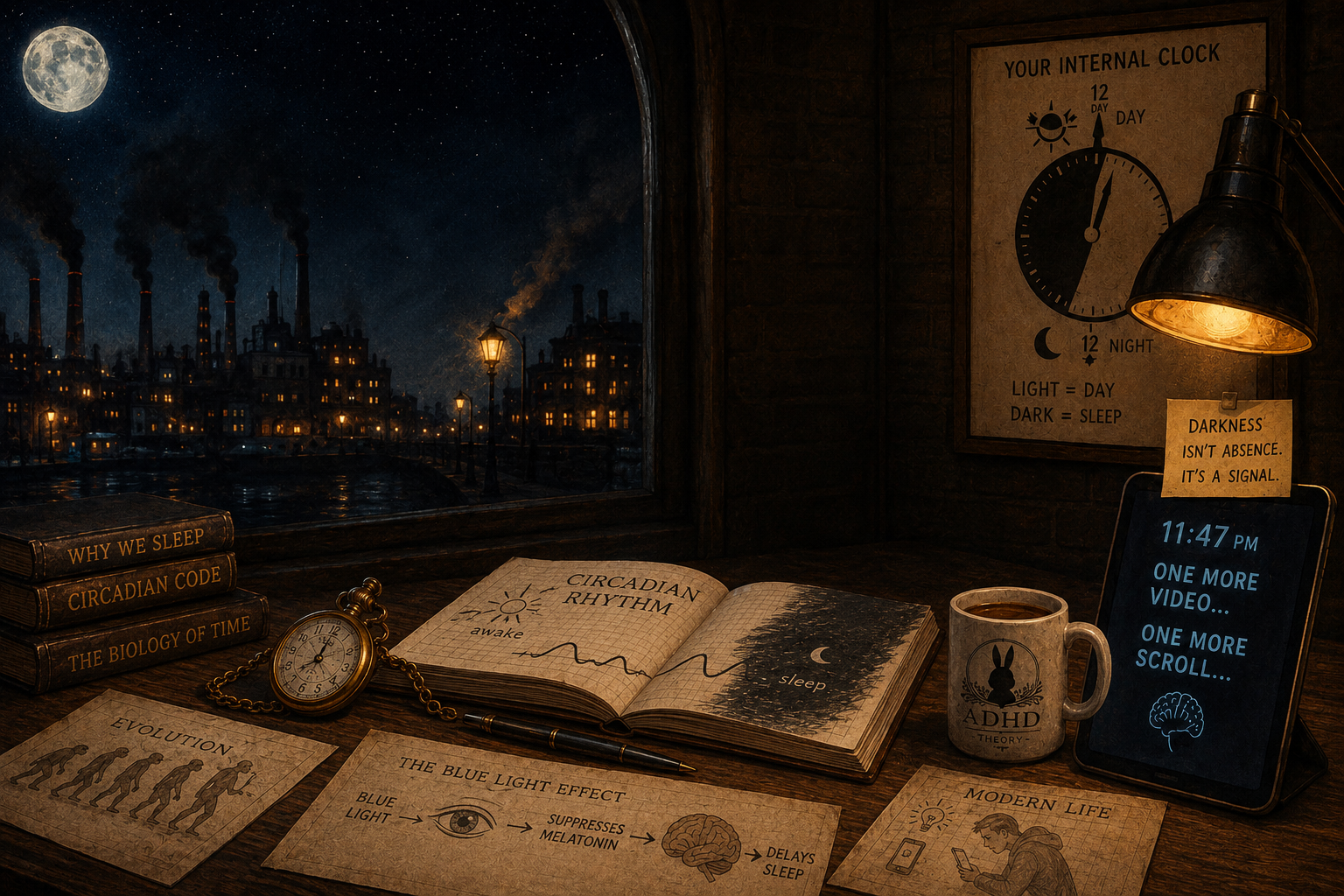
When you stare at a smartphone, laptop, or television screen late at night, you expose your eyes to concentrated blue light. Your brain interprets these specific wavelengths as daylight, halting the natural production of melatonin, the hormone responsible for signaling sleepiness. Essentially, your phone tells your brain that it is still high noon, delaying your sleep cycle and making it exceptionally difficult to achieve deep, restorative rest.
The Hidden Costs of Ignoring Your Circadian Clock
It is easy to treat sleep as a flexible negotiation. We tell ourselves we can function on five hours of rest, substitute sleep with caffeine, or catch up on weekends. However, biological systems do not negotiate indefinitely. When we continually override our circadian rhythms with artificial light and late-night scrolling, the bill always comes due.
Research highlighted in modern sleep science demonstrates that chronic circadian disruption impacts far more than just morning grogginess. Exhausted healthcare workers make more mistakes, tired drivers experience delayed reaction times, and students attempting all-night cram sessions often perform worse than those who prioritize rest. Furthermore, prolonged sleep deprivation compromises immune function, elevates stress hormones, and interferes with the brain's nightly cleanup processes.
Why Adolescent Brains Suffer Most
The conflict between modern schedules and human biology is perhaps nowhere more evident than in education. During adolescence, biological clocks naturally shift, pushing teenagers toward later sleep and wake times. Yet, many high schools still demand that students arrive by 7:30 in the morning. Forcing a teenager to learn on a depleted, mismatched schedule ignores fundamental neuroscience, proving that our institutions are often built around productivity metrics rather than human biology.
Reclaiming Your Nightly Shutdown
Overcoming the modern blue light trap does not require retreating to a cave or abandoning technology entirely. Instead, it demands intentional boundaries that respect your ancient biological wiring. Simple changes—such as setting digital curfews, utilizing blue light blocking software on devices, dimming household lights in the evening, and allowing darkness to signal your transition into sleep—can dramatically improve your health, focus, and overall well-being.
Understanding the science behind your nightly shutdown reveals that sleep is not an optional luxury or a waste of time; it is the vital foundation that allows your waking life to function. To dive deeper into the fascinating history, neuroscience, and evolution of our nightly routines, Listen to the full episode and join us down the rabbit hole.
Frequently Asked Questions
Why does blue light specifically disrupt sleep?
Blue light has a short wavelength and high energy level, which strongly stimulates specialized light-sensitive receptors in the eyes called intrinsically photosensitive retinal ganglion cells (ipRGCs). These cells signal the brain's master clock to suppress melatonin production, tricking your body into believing it is daytime.
How long before bed should I turn off my phone?
Sleep experts generally recommend powering down screens and avoiding bright digital devices at least 30 to 60 minutes before your intended bedtime to give your brain adequate time to ramp up natural melatonin production.
Can blue light-blocking glasses actually fix my sleep schedule?
Blue light-blocking glasses can significantly reduce the impact of artificial evening light by filtering out the specific wavelengths that suppress melatonin. However, they are most effective when combined with behavioral changes, such as dimming room lights and reducing screen time.
What is a circadian rhythm?
A circadian rhythm is a roughly 24-hour internal biological clock running in the background of your body's cells, regulating physiological processes like sleep-wake cycles, hormone release, body temperature, and metabolism.

Polyurethane Foam vs Polymer Gel: What Makes Stress Balls Feel So Satisfying?