
BONUS: The Hidden History Behind Cake, Candles, And Wishes
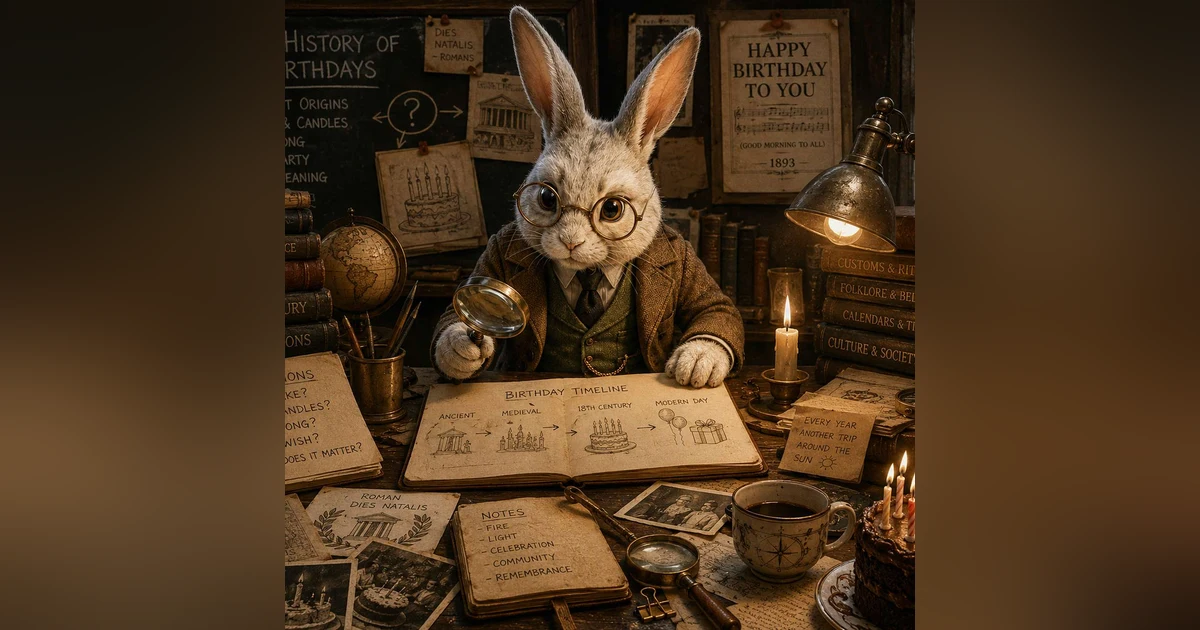

Send us Fan Mail There’s a cake on the table, tiny flames flicker in the dark, everyone sings the same melody, and then you’re told to do something oddly specific: make a secret wish and blow the fire out. We all accept it as “normal” which is exactly why we wanted to pull the whole birthday ritual apart and ask the deceptively simple question behind it: why do humans celebrate the day we were born? We trace the history of birthdays through the unglamorous essentials that make them possible ...


Key Takeaways
- Modern birthday traditions like cake, candles, and songs were not invented overnight, but rather assembled piece by piece across different centuries and cultures.
- Ancient civilizations like Rome used the concept of 'dies natalis' to mark repeating dates and significant events, establishing the foundation for personal birthdays.
- The tradition of putting candles on a cake originates significantly from Germany's Kinderfest celebrations in the 18th century, where candles originally represented a child's age plus an extra light for the future.
- Blowing out candles and making a silent wish likely evolved from a mix of ancient fire symbolism and smoke offerings meant to carry prayers upward.
- The universally recognized 'Happy Birthday' song actually began as a simple kindergarten greeting called 'Good Morning to All' written by the Hill sisters.
There’s a cake on the table, tiny flames flicker in the dark, everyone sings the same melody, and then you’re told to do something oddly specific: make a secret wish and blow the fire out. We all accept it as “normal” which is exactly why we wanted to pull the whole birthday ritual apart and ask the deceptively simple question behind it: why do humans celebrate the day we were born?
We trace the history of birthdays through the unglamorous essentials that make them possible like calendars, years, and the decision to treat a repeating date as meaningful. Along the way we visit ancient Rome’s dias natalis, household rites, and the sobering reality of childhood survival that makes “another year” feel like more than a number. Then we follow the candle trail from possible Greek moon symbolism to much clearer evidence in Germany’s Kinderfest traditions, where candles match your age and sometimes include an extra “light for the future.”
We also dig into how modern birthdays lock into place once cake ingredients and candles become affordable, and how the “Happy Birthday” song spreads worldwide after starting life as a kindergarten greeting written by Mildred and Patty Hill. Finally, we hit the weird corner where a family tradition collides with copyright law, plus the mind-bending “birthday paradox,” leap day birthdays, and the reminder that age is both biology and a cultural counting system.
If you like history, psychology, and the hidden logic behind everyday life, hit play, subscribe, share this bonus episode with a friend, and leave a review with your most unusual birthday tradition.
Follow us on Facebook: https://www.facebook.com/share/1BXmjoArss/?mibextid=wwXIfr
Instagram:
https://www.instagram.com/adhdtheory?igsh=MXZ6eGgzMGlvNHJy&utm_source=qr
TikTok:
https://www.tiktok.com/@adhdtheorypod?_r=1&_t=ZP-98QJNZBkBWI
Frequently Asked Questions
Who invented birthday candles?
There is no single known inventor of the birthday candle. The tradition evolved over time, with clear evidence appearing in 18th-century Germany where cakes featured candles representing a person's age.
Why do we make a wish when blowing out birthday candles?
The custom of making a wish and blowing out candles is a blend of ancient traditions that attributed mystical meaning to fire and smoke, with smoke symbolically carrying personal hopes upward.
Did ancient cultures celebrate birthdays?
While ancient Egyptians and Romans celebrated important dates, such as pharaoh coronations or the founding of cities, personal birthdays for everyday people were rarely celebrated the way they are today.
Where did the 'Happy Birthday' song come from?
The melody originally started as a morning greeting song for young children called 'Good Morning to All,' composed by Kentucky sisters Mildred and Patty Hill.
00:00 - The Birthday Ritual Up Close
03:29 - When Birthdays Flip From Future
09:34 - Calendars Before Parties Existed
12:37 - Rome Turns Dates Into Meaning
19:13 - Greek Moon Cakes And Smoke
21:21 - Germany Builds The Modern Cake
28:34 - Blowing Candles And Secret Wishes
31:41 - When Cake Becomes Affordable
33:47 - How The Birthday Song Spreads
40:40 - The Happy Birthday Copyright Fight
47:17 - Milestones Around The World
56:06 - Why Time Feels Faster Later
01:01:52 - Birthday Paradox And Space Facts
01:15:07 - Where To Find Us Next
The Birthday Ritual Up Close
SPEAKER_01There's a cake sitting on a table. Nothing really unusual about it. Maybe chocolate, a vanilla. There's probably somebody's name written across the top in icing. And sticking out of it are a handful of tiny candles. Somebody turns off the lights, the room gets quiet, a match, or a lighter, and one by one, the candles start to glow. Then everybody in the room starts singing the same song. You know the one. When they finish, everybody looks at you and waits. Because now you have to perform the ritual. You close your eyes, you think of something that you want. You're specifically told not to tell anyone what it is. And then you take a breath and blow out every little flame you can. And everybody cheers. And nobody thinks any of that is strange, which is strange in itself. Because if you strip away the familiarity for just a second, birthdays are weird. Once every year we celebrate the anniversary of somebody entering the world by gathering around a dessert, sticking fire in it, singing to them, and asking them to silently make a wish, and then they clap when we blow the candle out. Why? Why cake? Why candles? What's with the wishes? And why that song? Why do we care so much about the exact date that somebody was born in the first place? Because birthdays aren't really something nature gives us. There's no biological alarm that goes off inside your body once you've you know did another trip around the sun. At midnight, you don't suddenly become noticeably older. The universe doesn't stop, the sun keeps shining the next day, the earth just keeps spinning around. But we notice, we count, we remember, and once every trip around the sun, we stop everything for a minute and say, You were born on this day, you were here last year, and you're still here now. Somewhere along the way, humans decided that was worth celebrating. We baked cakes, lit candles, wrapped gifts, sang songs, and we turned one ordinary square on the calendar into probably the most personal holiday a person will ever have. But those traditions didn't really show up all at once, did they? Some of them are a lot older than you'd probably guess. And others are surprisingly recent. And a few have some histories that are a little bit stranger than the birthday parties they eventually became a part of. So today, we're following the rabbit hole through kings and calendars, ancient rituals and German bakeries, children and time, cakes and candles. All because one deceptively simple question. Why do we celebrate the day that we were born?
When Birthdays Flip From Future
SPEAKER_00There's something different about birthdays when you're a kid.
SPEAKER_01You don't just know your birthday is coming, you feel it coming. You count the months, then the weeks, then the days, and the night before your birthday somehow feels different from every other night of the year. Because tomorrow, something changes. You'll be eight or ten or thirteen. And when you're young, one year feels enormous. A birthday means you're getting closer to something. Closer to being tall enough, or old enough, or trusted enough.
SPEAKER_00Sixteen means you can drive. Eighteen means adulthood. Twenty-one means another invisible door opens. Birthdays point forward. And then somewhere along the way, it just kinda changes.
SPEAKER_01The countdown gets a lot quieter. It calms down. The numbers stop opening quite so many doors. 32 becomes 33. 46 becomes 47. And the day that used to measure how close you were getting to the future starts measuring something else. How much of the past you've accumulated.
SPEAKER_00That's a strange transformation.
SPEAKER_01Because the birthday itself hasn't changed. It's still just a date. It's a date on a calendar that says on this particular day, however many years ago, you arrived. But humans have spent thousands of years making that data mean something.
SPEAKER_00And we haven't always agreed on what, really. Like, for some people, birthdays were connected to power. And others, they were connected to religion.
SPEAKER_01And some family. For a surprisingly long stretch of history, depending on where and when you lived, your birthday might not have been particularly important at all. There were no balloons waiting for you, there was no pile of presents or no cake and candles.
SPEAKER_00Maybe you didn't even know the exact date you were born.
SPEAKER_01The birthday we recognize today had to be built piece by piece, culture by culture, and tradition by tradition.
SPEAKER_00And that's what I love about things like this. Birthdays feel inevitable.
SPEAKER_01Like of course we celebrate 'em, and then there's cake and candles and the sing. Until you ask why, then this perfectly ordinary little celebration starts coming apart in your hands. Because somebody had to put the candles on the cake. Somebody had to decide that they should be blown out. Somebody somewhere wishing became involved, somehow.
SPEAKER_00Somewhere presence became expected.
SPEAKER_01And somehow millions of people who agree on almost nothing learned to recognize the same little ritual over and over again. Light the candles, sing the song, make a wish, blow, and celebrate another year.
SPEAKER_00So that's where we're going. We're gonna go back through the history of birthdays to find out how all this happened.
SPEAKER_01But I also want to follow this rabbit hole a little bit further. Because eventually the question stops being, where did birthdays come from? and becomes why do we need them? Like, why does knowing that somebody completed another year matter to us? Why do we keep track? Why do we like why do we get together? Why do we celebrate? Maybe a birthday isn't a celebration of getting older. Maybe it's something a lot simpler than that. But for one day, the people around you stop looking at the calendar as a measurement of months and years and use it to measure you. One more trip around the sun, another year of stories, another year of becoming whoever you're becoming. You're still here. And apparently, humanity decided a really long time ago that that was worth lighting a few candles for. I'm Andrew Perry. This is ADHD in the theory of all the things. And today we're going to talk about birthdays. Welcome to the bonus episode. Let's follow the rabbit hole. Because there's always another question hiding underneath it, and then another one after that. Until something you've seen a thousand times suddenly becomes something you'll never look at quite the same way again. That's what we do here. We follow the rabbit hole through history, science, people, accidents, ideas, and all the strange little decisions that somehow built the world around us. And today, we're gonna go to a birthday party. Not for the presents and not even for the cake. We're going because somebody stuck fire into that cake and somehow convinced the rest of humanity that the birthday person should make a secret wish and blow it out. And nobody really seems concerned with how weird that is. So, let's follow this rabbit hole.
Calendars Before Parties Existed
SPEAKER_01And it looks like we're gonna start way before the cake. If we want to find the first birthday party, we have a bit of a problem. Nobody left us an invitation. And there isn't some big giant clay tablet sitting in a museum that says, you know, come celebrate Steve turning 37, bring beer. Just I mean, and that makes that makes the beginning of the story kind of difficult. Like, if you search for the origin of birthdays, and you'll I mean you'll find a little tidy version of history. It usually begins in ancient Egypt, and the story goes that Egyptians were the first people to celebrate birthdays, except they weren't celebrating the day someone was physically born. They were supposedly celebrating the coronation of a pharaoh, like the moment he became a god. I mean, it's a great story, and there's a smidge of a problem with it, though. The evidence for calling those ceremonies the first birthdays is kind of shaky. Ancient Egyptians absolutely celebrated their pharaohs. Coronations mattered enormously, and like royal anniversaries mattered, and But the pharaoh occupied a religious position that's difficult to compare with anything in our modern world. But taking all that and saying, and therefore Egyptians invented the birthday party is a much bigger leap than you know we would want to take. History usually isn't really that cooperative. Like what we can say is that ancient civilizations were already deeply interested in something that would eventually become essential to birthday, which was the importance of a particular day. Like a day could mark the beginning of a reign, or the founding of a city, or a religious event, victories and deaths and births. But once humans had calendars sophisticated enough to recognize that a particular day had come around again, then we could do something a little fascinating. We could remember an event not just as something that happened, but as something that will come back every year. That idea it seems completely normal to us now. But think about what has to happen before a birthday can even exist. First, you need some way of measuring a year. Then you need some kind of calendar, and then somebody needs to record or at least remember the approximate day that you were born. And then finally, your culture has to believe that when that date comes around again, it actually has meaning to it. And that there's a okay, so there's a lot of infrastructure just to put 33 candles on a cake. And way before birthday parties looked anything like ours, ancient people were already experimenting with this kind of funky relationship between people and dates and memory.
Rome Turns Dates Into Meaning
SPEAKER_01Eventually, we arrived somewhere that begins to feel a little bit more familiar, which is in Rome.
SPEAKER_00Now the Romans had a phrase, which was Dias Natalis, literally a birthday, like birth space day.
SPEAKER_01And the Romans they use the idea a lot more broadly than that, though, a lot more broadly than we do. Like a Dias Natalis would it could commemorate the birth of a person, but I mean Rome Rome Rome could also celebrate the birthday of something else entirely. Like they would they a temple could have one, or an institution of cities. I mean, Rome itself has a birthday, April 21st. Tradition eventually placed the founding of the city, anyways, on April 21st, 753 BC. So whether Romulus actually stood there on that particular day and just founded Rome is another question altogether. Maybe we'll visit that one one day. The Romans didn't need the story to pass a modern historical fact check.
SPEAKER_00Like the date mattered because they had decided it mattered. So centuries later, they're still celebrating it.
SPEAKER_01Under the Emperor Hadrian, coins were struck. Like they were commemorating uh games that were connected with Rome's 874th birthday. So think about that. Like, however many years ago, 2,000 years ago, people were already doing something pretty similar to what we do now. They were taking something that was enormously complicated, like the existence of an entire city, and giving it one day on the calendar where everybody could stop and say, This is where it began. And Romans they did recognize birthday, like regular personal birthdays, too. Like within um Roman household religion, birthdays could be occasions for offerings and rituals. Like the birthday of the head of the household had particular religious significance connected with his genius, like a protective, regenerative spiritual presence that was associated with him. Which means a Roman birthday wasn't necessarily like congratulations, you're 42. It could also carry religious meaning. So your birth wasn't really an event in your biography, it had a place in the spiritual structure of the household. But there's something else that ancient Rome something else they did that changes the way that people think about birthdays. Like, uh, because being born was just the beginning. Like, Roman infant mortality was brutal. It was ridiculous. I mean, the estimates vary, as you know, they do when you're trying to reconstruct ordinary life thousands of years ago, but the evidence suggests that roughly one-third of Roman children either died during childbirth or within their first year. So surviving childhood wasn't something anyone could just, you know, assume that they would do. And shortly after a Roman child was born, there was another important day. For girls, it was traditionally the eighth day, and then for boys it was the ninth.
SPEAKER_00So they called it the Dius Lustrius, which I still don't really get that one.
SPEAKER_01It was it's a day of purification, a day when the child was named and formally welcomed into the family and the community. So, you know, for the first eight or nine days, you didn't exist at all. You you didn't have a name or nothing. Before we're even talking about celebrating another year of life, we're already looking at a civilization performing a ritual that essentially said, you know, this kid is here, this kid belongs to us, that's different from a modern birthday. But emotionally, it feels pretty close. Because underneath all the decorations we've added over however long it's been since then, that idea never really disappeared. I mean, somebody got here, and then we remember when and we mark it. So, of course, I mean, Rome still hasn't given us the birthday party sitting in your kitchen today, though. Like, there's no grocery store sheet cake or no balloons tied to the mailbox, none of that stuff. Like there's no presents on the table or nothing. And definitely there's no exhausted parents running around trying to get this stupid play set put together at 11 o'clock at night because somebody decided to get it for your son, and he can't put it together, so it's your job to do it.
SPEAKER_00Just just saying. Those things they're a lot further down the rabbit hole than than we are right now.
SPEAKER_01So but at this point something important has happened. Like a person's birth has become attached to a date, and the date can return. So when it does, people notice we have the beginning of the birthday, but we're still missing a couple of things. Like actually, we're missing several things. The cake, the candles, and uh one really weird instruction that every child learns without really they they don't ask why, they just close your eyes, make a wish and blow. They just that they don't question it, they just do it. I guess birthdays are just ingrained in there at this point. So we're gonna have to find the point where somebody put some candles on this cake. Like at some point, somebody decided to put fire on the cake. And I really want to know who looked at that perfectly good dessert and thought, you know what, this needs open flame. Unfortunately, history isn't really gonna give us one person. There's really no there's not a known inventor of the birthday candle. Like there's no Thomas Edison of the wax candles, but instead, like most traditions that survive long enough to become pretty standard, the birthday candle seems to have been assembled from older ideas.
Greek Moon Cakes And Smoke
SPEAKER_01Like one of the oldest possible trails that leads people anywhere near a birthday, or anywhere near what we see as a birthday cake with candles, goes back to ancient Greece. The Greeks worshipped Artemis. She was the goddess of the hunt, of wilderness, and of childbirth. And importantly, for our story, she was a goddess strongly associated with the moon. So offerings were made to her. And later, writers describe cakes being offered in connection with her worship. So from there, it was that's where it's generally assumed that one of the most repeated stories in the history of birthdays is the Greeks supposedly made round cakes to represent the moon. And then they placed candles on them so they would glow, like they would glow like the moon did.
SPEAKER_00And they would watch the smoke carry the prayers towards the gods. Which in my opinion sounds uh suspiciously perfect.
SPEAKER_01Like round cake, candles, smoke, wishes, uh birthday party solved, except not quite because there's uh there's a difference between two traditions looking similar and one actually like descending from the other. We don't have uh a neat chain of evidence connecting an ancient Greek offering to Artemis directly to the candles sitting on the birthday cake. The but that I mean the connection is possible, but it's it's it's a little far. But it's not something we can confidently draw a straight line through. Like you can't we can't write it out, but we can't say, you know, that's for sure it. And there's a there's a big gap between ancient Greece and the birthday party clock at the birthday party at Chuck E.
SPEAKER_00Cheese. Like so we I mean we need to keep looking.
Germany Builds The Modern Cake
SPEAKER_00So eventually, as we go along, the trail gets a little bit warmer, like literally, we we end up in Germany.
SPEAKER_01And around by the 1700s, uh birthday celebrations for children were developing pretty commonly among German families. So these traditions they were associated with something called Kinderfest. Kinderfest, sorry. A children's celebration. So the things they start looking a little familiar at the like once we're here, this is where we start to look like a regular birthday. It was a children's celebration, and there's a child, there's a birthday, there's a cake, and there are candles. And not they're not like candles vaguely associated with some religious offering thousands of years earlier. They're just candles connected to the age of the person being celebrated. So um in 1746, there was a count, and his name was Ludwig von Zissendorf, which is a lot to say. I'm telling you right now, that is a lot. He celebrated his birthday at Marienborn, and this was apparently not a man, like he wasn't really interested in being subtle with birthday cakes. So there was a recorded witness in oh, I forgot what year that was. Let me look back in my notes. Okay, so yeah, they got there, and in 1746, at the Count's birthday party, there was a guy there, and it was a witness named Andrew Frey, and he wrote down his description of the celebration. There were decorations, there were lights, and a really enormous hall, and then the cake. Frey described it as essentially as large as the oven could accommodate. Holes had been made in it according to the number of years the count had lived. And inside of each hole, there was a candle, and then there was another candle placed in the middle. So by 1746, we have something that is just unmistakably a birthday. You got the actual birthday, a cake, candles representing the years that you've been alive, and you know, so we're getting closer to a modern birthday cake. And then there's something about those candles that I love. Because like today they're decoration, and we buy a box of like 24 of them for a couple of dollars, and we light them for like 45 seconds, somebody blows them out, and then inevitably, just at any point, you somebody's gonna pull some like half-melted wax out of the frosting. That's just gonna be a chunk of it there, and then you're gonna sit there and end up you'll bite into a piece, I promise. But in the 18th century, candles weren't like the most dispensable, or well, dispensable, disposable, whichever word you want to use, thing. Good candles back then cost a lot of money. Beeswax candles, especially. So there were cheap candles made from animal fat. They existed, but they could smoke and they smelled really bad. So covering a cake in dozens of those little flames, it wouldn't like if you were gonna do that back then, it wasn't just a a thing to do because it was pretty, it was actually extravagant. Like to them, having candles on a birthday cake was something that you could only do if you could afford that level of richness, I guess.
SPEAKER_00You were literally, I mean, you were burning resources to celebrate the fact that somebody had lived another year.
SPEAKER_01Back then, candles were considered a resource. And for children, like the flames seemed to have taken on another meaning. So life. Some German birthday traditions included a candle for every year the child had lived, and sometimes with an additional candle representing another year to come. A light for the future is what they called it. Which it sounds really nice. In some accounts, the candles weren't really lit when dessert arrived. Like they would be lit earlier and kept burning, or they'd be replaced as they burned down until the celebration later in the day. The flame would go on for hours. Like the flame mattered to them. And suddenly the birthday candle feels kind of different because we use the phrase another year of life so casually these days. But there was an they actually had a candle on the cake to represent it. Just a little. I mean, if you dig a little bit deeper into it and you get kind of deep with it, there was a light on the cake that represented another year of life. It was small, warm, temporary, something you had to keep burning. And this was happening during a period when childhood was ridiculously fragile. Like a child's next birthday was never guaranteed. So, I mean, perhaps an extra candle for another year wasn't for decoration.
SPEAKER_00It was helpful. Maybe this light will still be here next year. There's another, so I found another description.
SPEAKER_01It was a few, it was like 40 years after that, I think, or I don't remember exactly when. There uh Johann Wolfgang von Goth, the German writer, he he'd become one of the giants of European literature later, but he remembered a birthday celebration in 1801, and he was turning 52, and when dessert arrived, the servants entered the room carrying a large cake covered in about 50 burning candles. So back then, 50 burning candles, there were so many that the candles were beginning to melt, and really they were really threatening the cake. They were threatening the whole room. But he mentioned, Goth mentioned something a little interesting. He compared it with the way that children's birthday cakes were done, which tells us something important. Like by the beginning of the 19th century, this wasn't just like one eccentric count. He was setting a cake on fire. The association between children's birthday, um, birthday cakes and candles were recognizable enough that Goth could just kind of casually throw it out there. Their ritual was becoming a tradition by this point. But we're still missing the part that you probably did at your last birthday because lighting candles is one thing, blowing them out is another.
Blowing Candles And Secret Wishes
SPEAKER_01And once again, like we just talked about, the original originally in Germany, they left those candles burning, remember? And they wanted to keep them lit as long as possible to try to represent, you know, warmth and life and stuff like that. But once again, we've reached a point where history gets slightly frustrating. We don't know the exact moment when somebody decided that the birthday person should just blow the candles out. Like there's later on in the 19th century where there are accounts where they describe the practice and eventually another rule appears, you have to blow them all out. So, preferably they want you to do it in one breath, and if you do, you get a wish. But you can't tell anyone the wish because apparently the universe has very strict birthday terms and conditions.
SPEAKER_00And think about how strange that rule is. So just visit visit with that for a minute. Children simply learn it.
SPEAKER_01The cake arrives, the candles are burning, everybody sings, and then somewhere along the way, an adult tells you, make a wish. So close your eyes, and for a few seconds, in the middle of a noisy room full of people, you keep one thought entirely to yourself. And then you blow. The flames disappear, and smoke comes up from the cake, and everybody cheers. And maybe, I mean, I feel like maybe the smoke carrying, you know, the smoke going up. You know how we talked about that the ancient in ancient Rome when they would blow the candles out, or that the smoke from the candles actually go up to the heavens for their wishes or whatever it is. That I mean, that gets real similar here. So I I get where they're coming from. But anyways, you you're in front of the cake, you blow out the candles, the flames disappear, and then smoke comes up, everybody cheers and clap and all that stuff. Like, the smoke is might be carrying some kind of private hope upward. I get it. Like, I'm I'm with them on that. The ancient Rome thing and the connection there. I got it. Maybe humans really just like giving meaning to fire. We don't know exactly because uh we try to give meaning to everything, and I actually like the answer better. Like, I like that answer better because traditions don't always have like one person connected to them or one event because they just grow over time. One family can do something and then another one copies it, and then somebody changes it, and then a kid remembers it, and then they do it for their child, and then over and over and over again you develop superstitions and stories and all that kind of stuff. Like a century goes by, and eventually nobody remembers why they're doing it anymore. They just do it.
SPEAKER_00They just know that this is what a birthday looks like.
SPEAKER_01But there was still a bit of a
When Cake Becomes Affordable
SPEAKER_01problem. For most of history so far, the the kind of birthday cake we're talking about wasn't exactly something everybody could just pick up on the way home from work. Like sugar was very expensive. Flour, once you actually got it to the point where it would be usable, was also expensive. Butter and eggs were just very hard to come by ingredients back then. So a beautiful birthday cake was a real luxury for a lot of people. And then the 19th century, like we started tweaking food a little bit back then. Industrialization really transformed the way that milling was done and you know, the availability of flour and stuff like that. Sugar became widely available to everybody. They opened a lot of commercial bakeries, so things were kind of going along at this point. They were getting improvements in ovens, and then they had like chemical, the leavening stuff that kind of changed what home bakers could do. Candles also around then, they were a lot cheaper because we had electricity at this point. Candles started to develop to develop themselves into more of a decoration and like a scent type of thing. But they did get a lot cheaper, and then they had all kinds of materials that were getting developed to be able to help candles and help with the production of candles and make them cheaper. Slowly but surely, the ingredients of the birthday cake started to belong primarily to people with money. Like it stopped doing that. The cake was pretty much down the social ladder at this point, and it made it to everybody. Like candles and cake and all that stuff just trickled their way down to people who could actually afford it, and that matters because traditions spread a lot faster when ordinary people can afford to participate in them.
How The Birthday Song Spreads
SPEAKER_00So we all know the song, right? The happy birthday song. I mean, it's the most familiar thing, I think, in the world.
SPEAKER_01Because there's no birthday party today that really feels complete until a room of a bunch of people just performs a tiny piece of music that almost everybody on the earth seems to know. It's so familiar you probably can't even remember learning it.
SPEAKER_00I don't. I feel like I've always known it. Um it didn't really start as a birthday song at all. The original song, so the song everybody knows. We I'll give you so you could take the first four notes.
SPEAKER_01Yeah. Wait, one, two, whatever it is. You take the first little bit of it, and that's all you hear, you're gonna know where it's coming from. There's a good chance that your brain already knows what comes after that. Because somewhere along the way, you learned a song that nobody really remembers learning at all. Your parents probably never sat you down and were like, okay, you're old enough now. It's time we taught you the birthday song. There were no lessons or sheet music, no practice, no nothing. You just it just happened. You heard it at your birthday, and then somebody else's, and then another, and then there it is. Eventually you know exactly what's going down. And it's almost impossible to imagine a birthday without it, really. Which is impressive considering the song wasn't originally even about birthdays, it was about saying good morning. So, our story, as far as the birthday song goes, we're gonna talk about two sisters in Kentucky, and their names were Mildred and Patty Hill. Mildred was born in 1859. Patty came along nine years later, and between them, I mean, they had exactly the right combo of skills necessary to accidentally create one of the most recognizable melodies on earth. Mildred was musical. She was a pianist, she was uh an organist, composer, and she was a musical, just a music scholar. Patty was an educator. She wasn't just somebody who happened to teach children, she really did become an important figure in the development of early childhood education in America. In the late uh 19th century, Patty was working with young children in Louisville, Kentucky. The sisters were more interested in creating songs and like ones that children could actually sing. So that's it's more important than it sounds because small children don't have really big vocal ranges. Like complicated melodies are very difficult for them, and complicated words are even worse. So if you want a room full of kindergartners to sing something together, it needs to be simple, like predictable, repeatable, very easy to remember.
SPEAKER_00So that's where Patty and her sister came in.
SPEAKER_01They created a little greeting song that they would say in the mornings in the mornings. So it was in 1893. It appeared in a book called Song Stories for the Kindergarten. And the song was called Good Morning to All. So the words were exactly what you would expect. It was a simple morning greeting, nothing about birthdays, nothing about cake or wishes or any of that. It's just a little melody that was designed for children to be able to sing. Now the melody is what becomes the birthday song. So the story gets a little frustrating here because we'd love to know who looked at it, like who took the good morning to all song and was like, you know what? Hang on, we can use this for birthdays. And we don't know, like, we don't know there's there's stories and there are claims, but there's so many of them that none of them can actually be 100% proven. Like, I mean, the historical trail isn't really very clean on this one at all. Like, it's not clean enough for us to confidently point to one birthday party or uh anywhere and be like, no, there, there, that's the moment. But what we do know is that people started putting birthday words to that familiar melody. So we can trace it back to the melody just based on that. I mean, references like the references, they started showing up um around the beginning of the 20th century, and then around by 1911, the uh familiar the birthday lyrics, they actually showed up in print alongside instructions that were indicating that they were sung to the melody of Good Morning to All. So I guess that's you at least know right there that it's happening. Like it's been switched over at that point. It was in the instructions, and it says, sing these words to the melody of Good Morning to All. And from there, the song just kind of escaped. That's really the best word for it. It escaped. Like schools, churches, children's parties, homes, party, like everywhere. Songbooks, they were in that song, it was everywhere. They didn't need cheap music anymore. It just happened. They learned it from each other. One generation would teach it to the next one, and then over and over and over again, they'd sing it every time someone had a birthday. And it was, I mean, if you think about it, that's an extremely powerful way for a song to spread. Anything to spread, really, because birthdays keep happening every single day, everywhere, all over the planet. You don't need a radio station to make the song popular, you just need a few people who sing it, and then you need to keep having people be born. And that's, I mean, that's one thing humans are reliable about. We're gonna, we're gonna have babies. There's gonna be a lot of them. So by the early um, by the 20th century, the birthday song was a 100% locked-in part of American culture. So then we had recordings, we had the ability to ability to record and make movies and radio, you know, you it was mass media, it was everywhere. So the song would get bigger and bigger and bigger, it just kept growing. So eventually, it was so familiar that hearing just the first couple of notes was enough. And you didn't need an intro, like everybody knew what they were gonna do, everybody knows the
The Happy Birthday Copyright Fight
SPEAKER_01song. But there was a funky little problem, though, for most of the 20th century. People were being told that somebody owned it. And not a particular, like, not a recording of it, the song itself, they tried to say that someone owned. And if you wanted to use it commercially, you could potentially have to pay some money. So this is where our harmless little birthday party, you know, wanders right into copyright law, which is not usually where birthday parties would go, obviously. But in 1935, the Clayton F. Summy Company registered copyrights connected with the arrangements of Happy Birthday to You. So those rights eventually passed through companies and acquisitions, and then a bunch of decades later, they ended up with Warner Chapel music. Now, Warner maintained that it controlled copyright in the song, which meant that you know you could stand around Grandma's cake and sing it without a lawyer kicking down the door and blah, blah, blah, blah, blah. Yes, you can, you know, I have legally you can't sing happy birthday without giving them some credit and all that good stuff. But I mean, like using the song commercially was the problem in movies and TV and documentaries, any kind of production. They wanted to, if like if they wanted to use happy birthday to you, you had to license the song.
SPEAKER_00And eventually everybody recognized the song. Like, so that's what it made the rights valuable, extremely valuable.
SPEAKER_01Like, think about it. Every time in a TV show or a movie or on the radio that the the happy birthday song was played, if you owned the rights to that, just imagine how that would be. So it really created this stupidly absurd situation where the most ordinary moment in human life could become legally complicated the second somebody pointed a professional camera at it or a microphone. A family could sing happy birthday around the kitchen table, whoop-de-doo, fine. But the same moment, the exact same one, put in a movie, now somebody wants money. And this went on for decades, like forever, until eventually somebody asked the question that everybody else was thinking. They were like, Do they actually own this? In 2013, there was a filmmaker named Jennifer Nelson. She was making a documentary, like, and it was appropriately named Happy Birthday.
SPEAKER_00Well, I don't know if it was named Happy Birthday. I can't remember anymore.
SPEAKER_01It was about Happy Birthday, like about the song itself. Now her production company was told that it would have to pay licensing fees to use the song. So they paid. But Nelson Nelson and the others, they challenged Warren Chapel's claim. And suddenly lawyers were digging through, you know, over a century's worth of songbooks and Copyright registrations with sheet music and like any document they could find to try to answer that question. And it sounded pretty ridiculous. Like, who owns Happy Birthday? And the answer depended on several things that people had spent decades treating as though they were one thing. So there was the melody, and then there were the original, like good morning to all lyrics, and then there were later birthday lyrics. There were um specific musical instruments and like well, I'm sure it's arrangements, and there were copyrights associated with each one. So the distinctions with all that mattered a lot because in 2015 there was a um a U.S. district judge, it was uh George H. King, ruled that Warner Chapel did not have a valid copyright in the birthday lyrics. Now, the company's historical copyright registration didn't give it what it had claimed. So the case eventually produced a settlement worth millions of dollars. And in 2016, the court approved that settlement. So after generations of people singing it, and then happy birthday to you was finally unquestionably free for everyone to use in the United States, which feels appropriate.
SPEAKER_00Because if any song belongs to anyone, I mean, it's I mean, if it belongs to everyone, it's gotta be this one.
SPEAKER_01There's something a little more interesting here than copyright law, though. Think about what the Hill Sisters were trying to do. They were trying to write like just a simple song for their little bitty kindergartners. They weren't trying to write one of the most popular songs, popular, famous songs in history. They were sitting in Kentucky just hanging out, making little small children be able to sing songs. Simple songs, easy to remember songs. Now, they succeeded. I mean, we can tell them that, like, way almost too well. Like their little melody became way bigger than a song. It was a ritual. Like, there are people who don't speak the same language, they don't practice the same religion, they don't eat the same food, like none of them. They're half a million miles away, and they still know the song.
SPEAKER_00Well, the melody.
SPEAKER_01And so, well, I mean, when it starts playing anywhere, everybody knows what's happening. So it's just wild to think that that one little melody traveled that far. And today, if you're gonna celebrate a birthday, it's it's an extraordinarily like huge amount of meaning for just a melody that lasts a few seconds. We weren't like not today, we're not simply celebrating somebody, we're telling them something. Like we're saying their name, everybody's looking at them, and the cake is in front of them, the candles represent their years, and for one brief minute, that person becomes the center of the room.
Milestones Around The World
SPEAKER_01And that's that's what brings us um to something birthdays do that almost no other holiday does. Christmas belongs to everybody who celebrates it. New Year's belongs to everyone who celebrates it.
SPEAKER_00Thanksgiving belongs to everyone who celebrates it. But your birthday, that is yours.
SPEAKER_01It's just one day attached specifically to the fact that you yourself exist. And I mean, once we have the cake and the candles and the wish and the song, there was only one more thing to do, right? We've got all that stuff together. What do we got? We had to turn the whole thing into a party. Which, I mean, it'd been a bit of a party before, but this it gets it's so much, it's grown so much. Like, there was a question, there's a question people start asking you when your birthday gets close. They're like, How old are you gonna be? And when you're six, this is fantastic. Like, you know the answer immediately. Seven. And seven is you know, clearly superior to six at that point, and seven is bigger, and seven sounds older. Seven-year-olds, they know things that six-year-olds just don't understand. And when you're a kid, age isn't just information, it's progress. Like, you know, like we talked about, you don't say you're eight, you say you're eight and a half. Adults don't do this. Like, we don't do it anymore. Nobody just mentions they're 43 and three-quarters. Like at some point, we just stop counting the fractions. But kids do because every fraction matters. You're moving towards something, like the next birthday, the next grade, the next privilege. The whatever little piece of independence you're about to gain next is what you're working towards. And then, you know, the other birthdays become huge. 13, 16, 18, 21. What is it, 25 for insurance? We even have names for some of them. I mean, they're called milestone birthdays. Like, as if life were a road and somebody hammered numbered signs into the ground along the way. But they're the okay, so here's the strange part. The milestones aren't universal. Like, everybody agrees that getting older matters. Like, we but we don't agree on which birthday matters. In the US, 16 was wrapped up with driving, like the sweet 16. Everybody watched that show on MTV, like my super sweet 16 and all of that. It it became its own whole thing. 18, it was the mark of legal adulthood in many contexts. 21 means alcohol. And because those ages unlock things, we build expectations around them. But move around the world, and the important numbers really aren't the same. Like in uh, there was a few uh Latin American countries, a girl's 15th birthday can be marked by a quincenera. And then, like you call you call a quinceñera a big birthday party, doesn't really capture it. It's like a coming-of-age tradition. It's full of family and community and religion for many families. You get formal clothes and music and food. You know, there's a it's a ceremony, it's a moment where childhood and adulthood meet in the same room. In Jewish tradition, another set of ages become important. Like 13 for a boy's bar mitzvah. And uh traditionally, it's like 12 for a girl's bot mitzvah. Although practices they vary a little bit among the Jewish communities, but again, they're not simply birthday parties, they're religious milestones connected to responsibility and participation. I mean, in Japan, so there's something I don't know if I'm gonna pronounce this right at all, but I looked it up like 17 times to try to get it figured out. It's um Shichi Gosan. Whatever that is, which is it means 753. It's a tradition that's it's really celebrated involving children at particular ages. Like most commonly it's girls at three and seven and boys at five. Which it, I mean, the custom varies every every family or so, but um families visit the Shinto shrines and children can wear traditional clothing, and once again, underneath the specific tradition is something humans seem to do everywhere. We just choose a number and we say, you know what, this one matters, and then they go with it. Though it's sometimes the number matters because you've gained something, but sometimes it matters, you know, it's really I don't know how to explain it. Sometimes it matters because you've gained something, and sometimes it matters um because you survived something, and then sometimes the number itself is considered dangerous. Like there are cultures where certain ages have accumulated superstition. In Japan, uh particular ages have traditionally been regarded as unlucky years called Yakudoshi. And the exact customs vary from here to there, but certain ages have been treated as periods when a person may be particularly vulnerable to misfortune. So uh it's an interesting kind of inversion on the birthday. So instead of congratulations, you made it to this age, it's more like congratulations, please be careful for the rest of the year. And you know, humans we invented something a bunch of ways to just make age complicated. Like some cultures historically counted age differently than we do, and okay, so take in the um in the traditional East Asian system, it's um they call it East Asian age reckoning. A baby could start life at one rather than zero, which I get I can sort of get there with that. Um, and rather everybody becoming a year older on their individual birthday, age could increase collectively with the new year. So um South Korea continued using versions of this system socially pretty well into the modern era before adopting the international age counting for official purposes in 2023. In 2023, that's whenever they decided to actually really like adopt the international age.
SPEAKER_00Isn't that wild?
SPEAKER_01Like 2023, which meant that depending on the system being used, one person could effectively have more than one answer, like more than one answer to how old are you? So same person, same body, different number. And that's when age starts revealing what it really is. It's just a measurement, but it's also a cultural invention. Your body doesn't know that you're 33, it knows cells and hormones and sleep and uh injuries, growth, repair, blah, blah, blah, blah, like where all of that. So it knows that time has passed, but it doesn't know that 33. Like, that's ours. We made that up. We made up birthdays. Numbers, we made up the number associated with it. And there's the really uncomfortable thing that birthdays eventually teach us, which is the numbers only move in one direction. So when you're young, that's exciting. Like you desperately want them to move faster. A nine-year-old would happily skip directly to 16 if given the opportunity. And but you ask that question to a 49-year-old whether they'd like to like to skip forward directly to 56, and the enthusiasm would just not be there. Somewhere along the way, birthdays changed direction, not literally, but psychologically. Like, as when we're kids, we look forward to them, and what happens when I'm older, you know, eventually we start looking backwards, though.
Why Time Feels Faster Later
SPEAKER_01Like, where did all that time go? And there's actually a reason the years can feel faster as we get older, like several reasons, probably. Uh psychologists have they have a few different thoughts and different explanations for our changing perception of time. One is proportional, like when you're five, one year represents 20% of your entire life. That's huge. But when you're 50, one year represents 2%. So the same trip around the sun is it's a completely different fraction of your whole life experience. And there's there's also theories involving, you know, memories and novelty. Childhood is packed with firsts. Like uh your first school, your first best friend, your first trip, first time you're riding in a road bike, first kiss, first job, first time living somewhere new. There, those novel experiences, they create uh really distinctive memories, but adult life is just repetitive. You wake up, you work, you go home, you sleep, you repeat. And when there's fewer things to distinguish one period from another in memory, months and years can seem compressed when we look forward. Which means one of the strangest things about getting older may not be that time actually moves faster. It's that our brains just store it differently. And birthdays are the things that make us notice. That's why birthdays can really become pretty complicated. They force a measurement.
SPEAKER_00Like most days, you don't think exactly how long you've been alive. You wake up, you drink your coffee, find keys, go to work, you know, live your life, do your thing.
SPEAKER_01And then just one day on the calendar shows up and hands you a number and 30, 40, 50, 70, like and then you think about it, and then you're comparing it. You know, where am I? Where did I think I'll be? What happened this year? What happened here on my last birthday? Like, who was here?
SPEAKER_00Who isn't here anymore? What did I lose? What did I gain? Who was I 10 birthdays ago? Who who am I now? And who am I becoming?
SPEAKER_01That's a lot of emotional responsibility for a day that also expects you to wear a paper hat and blow out some candles. But I mean, I guess like that's why the that's why the ritual itself survives, because birthdays give us something ordinary. Like, life life really it doesn't give us anything like that. Birthdays give us something that life doesn't, which is a marker. Life does not have chapters that are just set to be there. There isn't a little card that appears every few years that announces like part four, things get weird. You know what I mean? And mostly life just keeps happening every single day. One thing one Tuesday becomes another Tuesday, and then months are gone. And it's just in routine, and you just disappear into it. Years pile up so fast. A birthday interrupts it. It plants a flag at one specific position, and it says, You are here and not where you plan to be, not where everybody thinks you should be, you're just here, and you've traveled another year to get here, so congratulations. Which makes the cake, I mean, it makes a little more sense. And so the candles, one flame for every year, and not it's not because 37 is like inherently more important than 36, but because humans need markers. Like we need ways to make invisible things visible, and this is about as invisible as anything gets. You can't hold a year, you can't put 20 years on a table, you but you can put 20 candles on a table. Like you can light 20 candles and put them on the cake, look at them, and for a few seconds, time itself has a shape.
SPEAKER_00And then you take a breath and you blow it away.
SPEAKER_01Because that's why maybe that's why birthdays can feel really happy and uncomfortable at the same time. Like they are celebrations, but they're also reminders. Like the number's getting bigger and another year happened, and you don't get that one back. So perhaps I guess, well, the better question isn't how old are you? It's it's gotta be like what happened while you were becoming that old. Because the number isn't the life, it's just how we've decided to count it. And speaking of numbers, birthdays have produced some absolutely ridiculous ones. Um, people who lived so long that their ages became scientific investigations. There they've got uh birthday parties attended by thousands of people and cakes that needed more candles than any reasonable fire department would be okay with. People were born on dates that don't even really exist, and then there was one birthday coincidence that was so unlikely that it exposed something really weird about the way our brains understand probability itself.
Birthday Paradox And Space Facts
SPEAKER_01So before we go any further down the rabbit hole, we are going to scoot on to one of my favorite sections, which is that's wild. I'm gonna tell you guys a few things and we'll go, we'll see what we can find. This has been a very long episode, I will say that we've had a lot to talk about. Um but there were a few things that I found along along the way of looking for this um information in this episode.
SPEAKER_00So this is the part of the show where the rabbit hole kind of chills out, and we we just we just find whatever we can get. Um and birthdays are weird. So we'll start with 23 people.
SPEAKER_01Put 23 completely random people in a room and ask what are the chances that at least two of them share a birthday?
SPEAKER_0010%? 20? Maybe 30? Nope.
SPEAKER_01With 23 people, the probability is just over 50%, and with 50 people, it's about 97%. So get 70 people together, and the probability that two of those people were born on the same day is over 99.9%. Now, this is it's called the birthday problem or the birthday paradox, and it feels wrong because our brains tend to ask the wrong question. Like we imagine what are the chances that somebody shares my birthday? But that's not what we're measuring, really. We're asking whether any two people match. Like with 23 people, there aren't just 23 opportunities, there are 253 different pairs of people who can potentially match. And suddenly, 365 days doesn't seem really as spacious if you think about it. So But birthdays aren't they're not evenly distributed across 365 days either. Some birthdays are considerably more common than others. In the US, there's a very noticeable pattern, like late summer, late summer and September are really packed with births. Take it from me. I was born on September 6th. My birthday is just a couple of weeks away. Late summer and September have are just historically packed. So it's an an they did an analysis of American birth data, and so they found that September dates were among the most common birthdays, which means if you count backwards, nine months, yeah, December, Christmas, New Year's Eve, cold weather, people spending considerably more time indoors. I think we can all solve the rest of that mystery without having a degree. But, you know, here's where it gets better. So one of the least common birthdays in America is December 25th, which is Christmas Day. New Year's Day is pretty low too, and that's probably it's not because babies have like agreed to respect federal holidays.
SPEAKER_00Um one major reason reason is medical scheduling.
SPEAKER_01So birth, isn't it it's not entirely random anymore? So inductions and c sections, they are scheduled these days a lot of the time. And so when physicians and hospitals and families have they have control over the date. So they're not super keen on fighting for days and deliver delivery days and stuff like that. That they really aren't going to push for a baby to be delivered on Christmas Day. Like what doctor or nurse or anything wants to be in the hospital on Christmas Day? So you can see where the schedule gets kind of funky. Like it's they're only not born on those days because no one schedules C-sections or inductions for those days.
SPEAKER_00Now, there are people who got the rarest date you could think of, which is February 29th. Leap Day.
SPEAKER_01Now, the Gregorian calendar gives us a leap year generally every four years, which is it's a very important exception involving, you know, century years. But either way, a a year divisible by 100 isn't normally a leap year. Unless it's also divisible by 400. And that's why so that's why 2000 was a leap year, but 1900 wasn't, and 2100 won't be. That it's a funky little rule that exists because Earth's trip around the sun isn't exactly 365.25 days. It's just a tiny bit shorter. So without the correction, our calendar would slowly just really drift away from the seasons, which means that leap day birthdays exist because humans are essentially just performing long-term maintenance maintenance on the calendar. But if you were born on December 29th, so no, you don't legally like only age every four years. A person born February 29th of 2000 turned 24 in 2024, not six. Although, I really support putting six calendars on the cake, like just because you're that lucky to be born on that day, then have some fun with it. Like actually enjoy it. But so we'll leave we'll leave math for a second because I think I gave myself a headache trying to figure that out. Um because I'd already figured it out once, and then when I wrote it down, I think I confused myself again. But we'll leave math for a second and we'll go somewhere just a little bit more off. So there are places where your birthday historically wasn't the day that everybody became another year older. So everybody did it together. So, like I was talking about earlier, traditional East Asian, like the age counting systems, they were way different from the international system that we use. So, in the traditional Korean system, for example, a baby could be considered one year old at birth. And then everybody added another year at the beginning of a new year. So this it kind of created a funky little math problem where a baby born immediately before New Year's could turn two almost immediately.
SPEAKER_00So if you're born yesterday, you could be two years old today.
SPEAKER_01So congratulations on a really, really productive 24-hour period. Um, South Korea officially moved away from its traditional age counting system, as we said earlier in 2023, which they just adopted the international system that we have. But culturally, the older way of counting age had been pretty familiar familiar. Yeah, that word at that point, which it really reminds us of something that we've treated as obvious throughout this entire episode, which age itself is partly human-invented. Like your body is gonna age continuously, but saying I am 33 years old, which I'm 32 right now, but I'll be 33 in September, I think. When that's when counting, you know, whatever. We just we have to agree on a year when counting starts.
SPEAKER_00So when the number changes, that's that's when it that's when it starts. I don't understand. So now here's one that sounds this one sounds made up, but I thought it was funny.
SPEAKER_01Your birthday isn't actually the anniversary of Earth returning to exactly the same place in space where it was when you were born, it's not even close. Earth travels around the sun, but the sun itself is moving around the center of the Milky Way, and our entire galaxy is moving too. So when we say you've completed another trip around the sun, that one's true in one useful sense, but you haven't returned to where you started. You can't. The entire solar system has moved in that one point, like the whole solar system has moved. Earth travels, oh, I looked this up yesterday. Oh, that does. Okay, so um Earth travels roughly 940 million kilometers or like 580-something million miles around the sun in one orbit. So, meanwhile, the sun is carrying us through the Milky Way at hundreds of thousands of miles per hour. So every birthday of your life has happened somewhere in space that you've never been before. Ever. And you'll never occupy the same space again, ever. Your birthday isn't really a return to anything, it's just another loop in the whole journey across the Milky Way. So while we're thinking astronomically, um, so your age depends entirely on which planet is doing the counting. If you lived on Mercury, like the a year there is like 88 Earth days, you'd rack up birthdays super fast. You'd be like ancient at this point. A 30 two-year-old uh human on Earth would be what Yeah, so you'd be over a thousand years old. Move to Mars and suddenly birthdays are kind of scarce. A Martian year lasts six hundred and eighty-seven Earth days. And Neptune one trip around the sun takes roughly a hundred and sixty-five years.
SPEAKER_00So humans discovered Neptune in 1846. The planet didn't complete its first full orbit since that day that they discovered it until 2011.
SPEAKER_01So look at that. In 1846, we found Neptune, and then they decided to be rude and make him not a planet anymore and all that good stuff. But either way, the first orbit was completed in 2011, so one year lasted that long. So Neptune has had one birthday. In the entire history of humans knowing that Neptune existed, it's had one birthday. But here is my favorite one. So there's a decent chance that somewhere in the world right now, someone is celebrating their birthday. Well, actually, decent chance is under selling it um pretty dramatically. The United Nations estimates that there are more than eight billion people alive today. And so you divide that 8 billion people across 365 days, and really roughly, like you're pretty rough here, but we're talking about tens of millions of people sharing each calendar date as a birthday. So out of every day on the calendar, you've got like 10 million people, tens of millions of people, celebrating a birthday on any given day.
SPEAKER_00So the real distribution isn't perfectly even, if you think about it.
SPEAKER_01But the scale is still pretty wild. Like your birthday feels uniquely yours, and personally it is. But while your family is, you know, lighting your candles and all that other stuff, millions of other candles are being carried into other rooms on a cake.
SPEAKER_00Like it's happening all over the planet, millions and millions and millions of people at a time, at the same time.
SPEAKER_01It doesn't matter. You have different languages, you have different countries, different religions, and it's all the same thing.
SPEAKER_00All in the same day. But I feel like we have really dragged that one out.
SPEAKER_01We he we I rambled so much. I'm so sorry. But, anyways, that is our bonus episode for this
Where To Find Us Next
SPEAKER_01week. We were gonna dig into birthdays a little bit, and I think we learned a lot. I feel like a lot was learned here, and we did a pretty good job. So I want to thank all you guys for being here and coming out for the bonus episode. You can find us on Facebook at ADHD in the theory of all the things, and then also on our website at adhdtheory.com. Um, as far as the rest of that goes, we will see you guys next week. We'll have another episode Tuesday, and that one is going to be going over memory, and we're gonna find out exactly how your brain decides to work with that stuff. So, again, just take a rest for the rest of the day, and then don't be afraid to fumble the rabbit hole. I'm in your parody, and this has been ADHD in the theory of all the things.